Explanation and Introduction to JLPT N1 Grammar ★

There is difficult grammar that even Japanese people don’t use very often.
How should I introduce it…
After introducing and practicing,
have them actually create sentences and check for errors!!


there are cases where Japanese people would say it differently
or use different grammar…
so we have to learn the common usage together.
there are many students who can learn properly on their own,
so many students grow by studying problem sets on their own.
“Try" is a textbook for the Japanese Language Proficiency Test,
and its content is as follows.
① Reading comprehension containing the grammar that appears in that lesson
② Explanation of each grammar item that appeared in the reading comprehension
For each grammar,
・ Explanation of how to use the grammar
・ Explanation of grammar connections
・ Confirmation of which situations the grammar is used in (between friends/formal expressions/written language, etc.)
・ Practice problems for the grammar
・ Introduction of grammar with similar usage
③ Summary problems (comprehensive review of the grammar that appeared in that chapter)
・ Problems similar to the JLPT format are included.
Various styles such as multiple-choice, rearrangement, fill-in-the-blank, etc.
Also, listening comprehension problems containing the learned grammar are prepared.
“Try" is a book for JLPT preparation,
but while many preparation books treat skills separately as “reading comprehension," “listening comprehension," and “grammar,"
in “Try," all skills are learned in balance.
For each grammar,
you can conduct a lesson flow of reading comprehension, grammar and vocabulary learning, practice problems, and listening problems,
so it can be used like a general textbook without boring the learner.
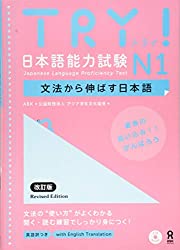
CD included TRY! Japanese Language Proficiency Test N1: Extend Your Japanese with Grammar
If you’re interested, please take a look!!
|
Chapter 1: “Oktoberfest" |
Chapter 5: “Changing Jobs (3)" |
|
Chapter 2: “Let’s Increase Industrial Physicians" |
Chapter 6: “After Training" |
|
Chapter 3: “The Wife Who Doesn’t Eat (1)" |
Chapter 7: “As Expected of Honda (1)" |
|
Chapter 3: “The Wife Who Doesn’t Eat (2)" |
Chapter 7: “As Expected of Honda (2)" |
|
Chapter 4: “How to Get Along with Your Boss (1)" |
Chapter 8: “Moeka of Paradise (1)" |
|
Chapter 4: “How to Get Along with Your Boss (2)" |
Chapter 8: “Moeka of Paradise (2)" |
|
Chapter 5: “Changing Jobs (1)" |
Chapter 9: “Triage" |
|
Chapter 5: “Changing Jobs (2)" |
Chapter 10: “Avant-garde Calligraphy" |
Above are the titles of each lesson, the appearing grammar points, and the reading material styles.
The scope of N1 and N2 is ambiguous, so
if the explanation of the grammar you are looking for is not there,
please also check the explanation page of “Try N2" grammar.