Teaching Plans and Materials for “Minna no Nihongo” Lesson 9: How to teach words using “ga” ★
In this lesson, the particle “が" is introduced.
Since “~から" will be used often from now on, make sure to teach it thoroughly.
We need to ensure we can teach how to use “とても", “よく", “だいたい", “たくさん", and “すこし" correctly.
Students with an English-speaking background often get this order reversed.
Let’s pay attention to that…
they will be able to construct even longer sentences than before!

「Being able to use the particle “が" with adverbs in conversation.」
「Being able to state reasons.」
~が好きです
(Draw a picture of a fish on the whiteboard, next to it draw a picture of a person with a heart coming out of their head)
(Draw a picture of a person with a jagged heart coming out of their head next to the previous picture of the fish)
To illustrate different intensities like “とても" (very), “あまり" (not much), “ぜんぜん" (not at all), “嫌い" (dislike), increase the number of hearts or add a skull mark.
Practice with flashcards
わたし は さかな が とても すき です。
すき です。
あまり すき じゃありません。
すき じゃありません。
ぜんぜん すき じゃありません。
とても きらい です。
きらい です。
(Do not cover “あまり嫌いじゃありません。" or “全然嫌いじゃありません。" as these are nuanced.)
~が好きですか。
|
Teacher A-san, do you like coffee? Yes, I like it very much. 
学生さん 
Teacher B-san, do you like coffee too? No, I don’t like it very much.
学生さん |
Ask other students as well to introduce the topic.
Q:コーヒー が すき ですか。
A:はい、とても すき です。
はい、 すき です。
いいえ、 すき じゃありません。
あまり すき じゃありません。
きらい です。
どんな~が好きですか。
|
Teacher A-san, do you like fruit? Yes, I like it.
学生さん
Teacher What kind of fruit do you like? I like mandarin oranges.
学生さん
Teacher B-san, what kind of cars do you like? I like small cars.
学生さん |
It is also good to check answers using nouns and adjectives.
Q:どんな くだもの が すき ですか。
A: みかん が すき です。
Q:どんな くるま が すき です か。
A:ちいさい くるま が すき です。
べんり な くるま が すき です。
トヨタ の くるま が すき です。
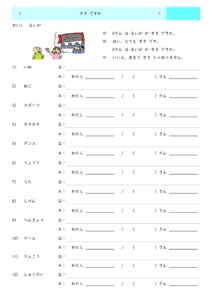
Teaching materials for Japanese grammar “Do you like ~?" and “What kind of ~ do you like?"
上手です
(Draw a picture of a person cooking on the whiteboard, draw a thumbs up next to it)
(Draw a picture of a person cooking on the whiteboard, draw a thumbs down next to it)
Give more example sentences.
Explain that it’s not common to use “上手です" (good at) for oneself.
Also mention that “下手です" (bad at) can be considered rude, so avoid using it for others.
りょうり が とても じょうず です。
じょうず です。
あまり じょうず じゃありません。
ぜんぜん じょうず じゃありません。
へた です。
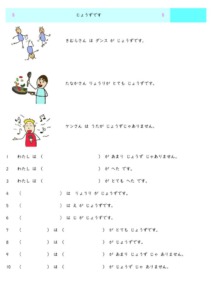
~がわかります
(Write random hiragana on the whiteboard)
|
Teacher Everyone, what is this? “み", “ゆ", “き", “し", “そ" …
学生さん
Teacher You all understand hiragana. |
(Write unfamiliar kanji on the whiteboard)
|
Teacher What is this? ….
学生さん
Teacher You all don’t understand kanji. |
(Write katakana on the whiteboard, including some difficult ones like “フェ" and “ヴィ")
|
Teacher What is this? “メ", “ア", “…", “モ", “…" …
学生さん
Teacher You all understand most katakana. |
Ask questions that prompt responses like “よく" (well), “すこし" (a little), “あまり" (not much), “ぜんぜん" (not at all).
For answers like people’s names or phone numbers that have a single correct response, do not use adverbs like “よく" or “あ
まり".
For “すこし" and “あまり", the degree of understanding can vary based on the speaker’s feelings.
ひらがな が よく わかります。
カタカナ が だいたい わかります。
かんこくご が すこし わかります。
かんこくご が あまり わかりません。
ロシアご が ぜんぜん わかりません。
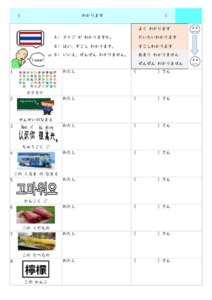
The second half covers “あります" (existence) and “~から" (reason).