Teaching Plans and Materials for “Minna no Nihongo” Lesson 4: How to teach “Time,” “Days of the week,” and “Phone numbers” ★

Verbs start appearing from this lesson onwards.
The changes at the end of the sentence due to tense are tricky.
But don’t worry.
Even if you can’t smoothly transform the sentence endings due to tense differences in this lesson,
verbs will continue to appear in the following lessons,
so you’ll naturally be able to say them smoothly in no time.

If the teacher doesn’t consciously incorporate tense in practice,
it will take a considerable amount of time to master…
let’s first check the goals of this lesson.
To the point, it’s this!!

1. Be able to say the time and days of the week.
2. Understand how to construct sentences with verbs.
Let’s make sure to have them memorize the vocabulary thoroughly!!
Time (~時~分)
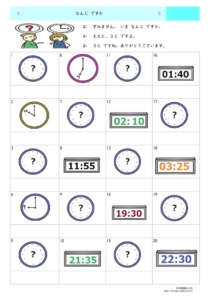
Introducing time using a clock without batteries…
Pay attention to 4 o’clock, 7 o’clock, 9 o’clock, and the differences between “fun" and “pun", and “han".
に じ じゅっ ぷん
さん じ じゅう ご ふん
よ じ にじゅっ ぷん
ご じ にじゅう 五 ふん
ろく じ さんじゅっ ぷん / はん
しち じ さんじゅう 五 ふん
はち じ よんじゅっ ぷん
く じ よんじゅう 五 ふん
じゅうじ ごじゅっ ぷん
じゅういち じ ごじゅう 五 ふん
じゅうに じ
Some students might add “fun" to “han" and say “9:30 minutes", so let’s be careful.
Practice saying the time using clocks and picture cards.
Practice listening to the time said by the teacher.
What time is it?
Teacher What time is it now? It’s 10:15. 
学生さん |
Q: いま なん じ ですか。
A: 10じ15ふん です。
AM and PM
(Use a map showing world times if available…)
|
Teacher Excuse me. What time is it in Japan now? It’s 10:30.
学生さん
Teacher Then, what time is it in Brazil now? It’s 10:30.
学生さん
Teacher What? Is it 10:30 in Brazil too? No, it’s 10:30 PM in Brazil.
学生さん
Teacher Ah, it’s 10:30 PM… |
Q:にほん は いま なんじ ですか。
A: ごぜん10じはん です。
Q:ブラジル は いま なんじ ですか。
A: ごご10じはん です。

~は~曜日です。
|
Teacher Everyone, what day is it today? It’s Wednesday.
学生さん
Teacher What day is tomorrow? It’s Thursday.
学生さん
Teacher What day is the hiragana test? It’s Friday.
学生さん (Be careful not to use terms like “yesterday" and “the day before yesterday" as they turn into past tense sentences like “was ~.") |
Q:きょう は なんようび ですか。
A: すいようび です。
Q:あした は なんようび ですか。
A: もくようび です。
Q:テスト は なんようび ですか。
きんようび です。
It’s from ~ to ~.
(Draw a picture of a company with work hours and holidays written on it)
|
Teacher What are the work hours of the company? It’s from 9 to 6.
学生さん
Teacher What day is the company holiday? It’s Saturday. And Sunday.
学生さん |
Q:かいしゃ は なんじ から なんじ まで ですか。
A: 9じ から 6じ まで です。
Q:かいしゃ の やすみ は なんようび ですか。
A: どようび と にちようび です。
It’s easy to remember the particle “と" (to), so they’ll naturally remember it.
However, in English, when listing three or more items, it becomes “A, B, C, and D".
In Japanese, even when listing three or more items, you use “と" (to) every time, like “AとBとCとD".
Make sure to explain this.


Phone Numbers
(Add phone numbers to the previous whiteboard drawing)
|
Teacher What is the company’s phone number? 019 ✖✖○○ ○✖ ✖○です。
学生さん |
Q:かいしゃ の でんわ ばんごう は なんばん ですか。
A: 019 ー ✖✖○○ ー ○✖ ✖○
Teach them that the hyphen in phone numbers can be read as “no".
Also, mention that the sounds of “2" and “5" become elongated like “nii" and “goo".
In the second half, verbs will appear…
Will it be alright?