Teaching Plans and Materials for “Minna no Nihongo” Lesson 3: How to teach “Here, there, over there,” and “What is your country/company?” ★
|
Lesson 3 has a lot of vocabulary too. Let’s naturally teach vocabulary through practice. 
先輩さん This is the goal for Lesson 3! 
ベテランさん Objectives for “Lesson 3" in Minna no Nihongo
Be able to say where things or people are located. 
中堅さん The latter part takes quite some time to practice large numbers… Well, you can hand out printouts and say, “Please memorize them," but it’s up to the students’ efforts after that… It’s up to you as the teacher to decide how to proceed. 
新人君 Since this lesson has a lot of content, I’ll be careful with time allocation. |
Here/There/Over there is ~.
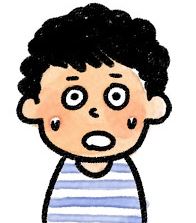
There is the restroom.
Over there are the stairs.
“Asoko" refers to a place that is visible or can be anticipated even if not visible.
Koko wa kyoushitsu desu.
Soko wa toire desu.
Asoko wa kaidan desu.
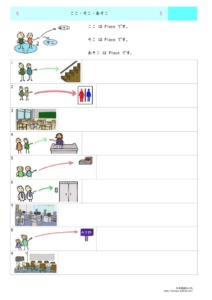
Where is ~?
(Draw a person on the whiteboard who seems to have a stomachache…)
Where is the restroom?
(Draw another person pointing to a distant restroom… and prompt the student to answer.)

(Draw a person holding their head on the whiteboard…)
(Draw another person answering with a place name… and prompt the student to answer.)
(If it’s not visible, confirm to answer with the place name instead of using “here," “there," “over there.")
Practice with pictures of items in the classroom and famous buildings in the world and Japan.
It’s practice to ask where someone is!!
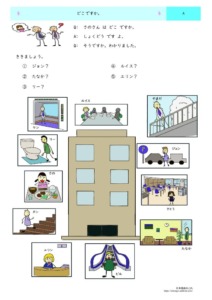
You can download the materials from here.
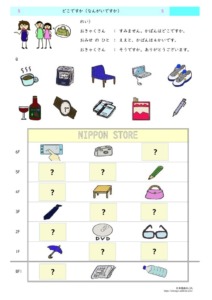
What floor is ~ on?
(Draw a picture of a department store on the whiteboard. Draw items on each floor.)
|
教師 Excuse me. Where is the camera section? What floor is the camera section on? It’s on the third floor.
学生さん
教師 Excuse me. What floor is the cafeteria on? It’s on the basement first floor.
学生さん |
Q: Kamera uriba wa doko desu ka?
Kamera uriba wa nangai desu ka?
A: Kamera uriba wa sangai desu.
Q: Shokudou wa nangai desu ka?
A: Shokudou wa chika ikkai desu.
Which way is it? / This way, That way, That way over there
Since this is practice for switching from “koko," “soko," “asoko," “doko" to “kochira," “sochira," “achira," “dochira," you can use the same picture cards you used to introduce “doko desu ka."
Using the same situation makes it easier to understand that only the words change.
Which country are you from?
(Select a student)
|
教師 Which country are you from, ~san? I’m from China.
学生さん |
Q: ~san no okuni wa dochira desu ka?
A: Chuugoku desu.
Ask other students as well.
Practice with picture cards.
Sometimes students may misunderstand and answer with “Europe," “America," etc.
Confirm that it’s the name of the country, not the location.
Which company/university are you from?
Select a student (or use a picture with the name and address of a company)
|
教師 Which company are you from, ~san? It’s (company location).
学生さん
教師 The company name, please. It’s (company name).
学生さん |
Practice with university and hospital names as well.
Q: ~san no kaisha wa dochira desu ka?
A: (Kaisha no namae) desu.
