Teaching Plans and Materials for “Minna no Nihongo” Lesson 16: How to teach “~te,” and “~tekara” ★
In this lesson, we will continue learning sentence patterns using the “te-form".
Students might also forget some vocabulary for adjectives…
“Be able to explain daily actions in sequence"
“Be able to describe things and places by connecting adjectives"
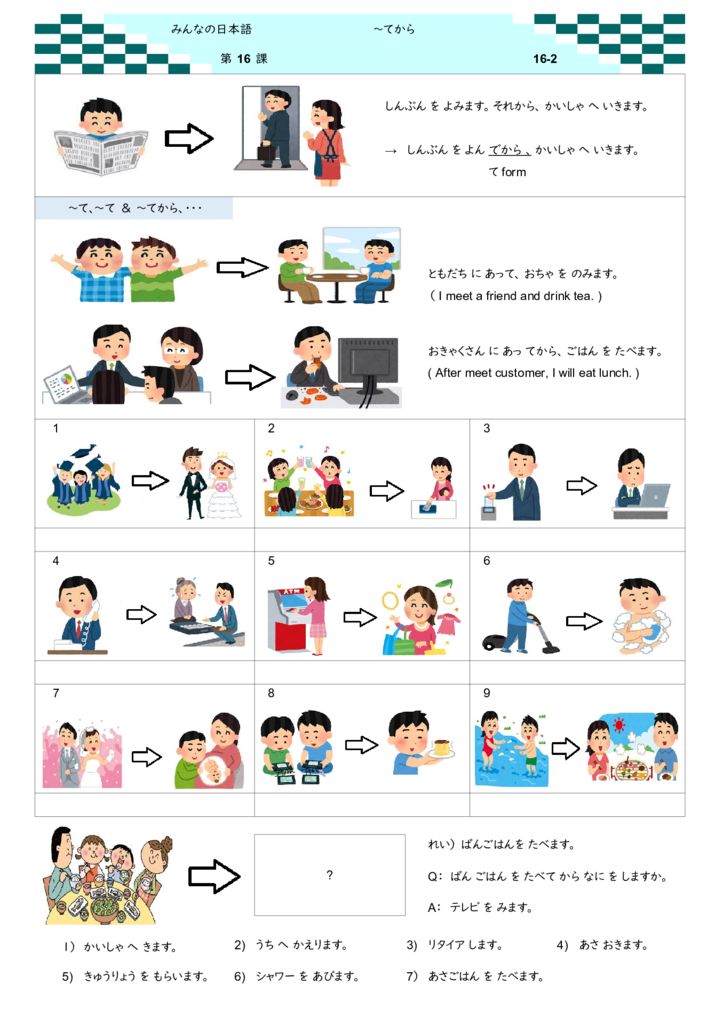
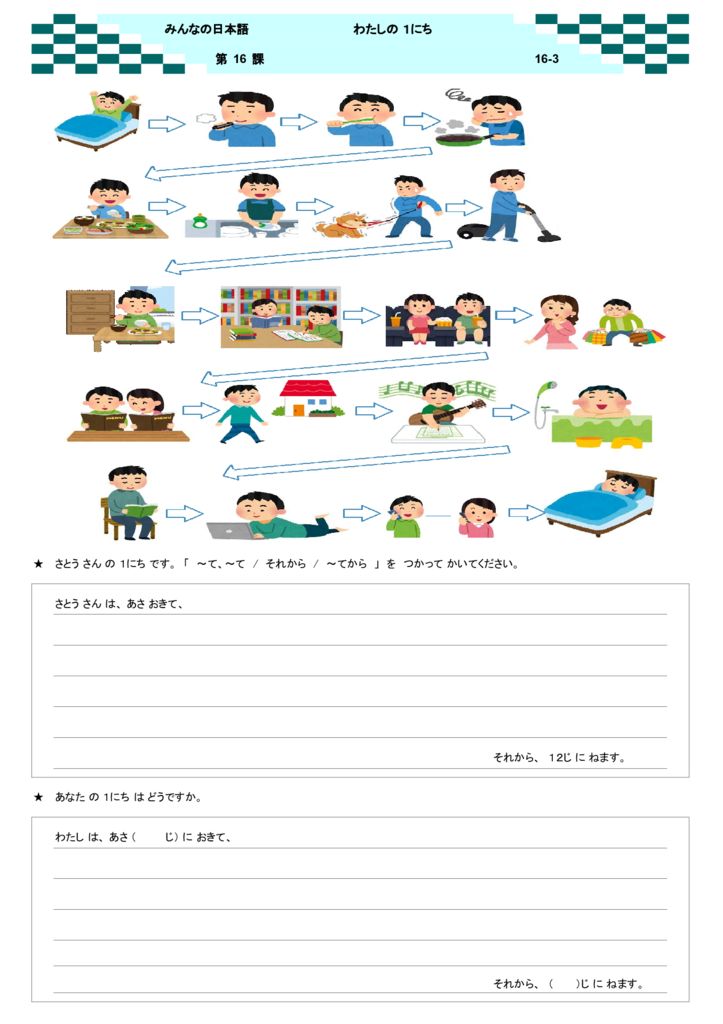
~て、~て
Be careful as the difference between “~て、~て" and “~てから" can be difficult to understand.
It’s easier to explain with examples: use “~て~て" for continuous actions, and “~てから" for actions that occur after A finishes and B starts.
(Draw a picture of a vending machine on the whiteboard)
教師 Everyone, you want to buy a juice. What do you do first? Insert money. 
学生さん
教師 You inserted the money. What do you do next? Press the button.
学生さん
教師 That’s right. You insert the money and then press the button. (Draw a picture of a station on the whiteboard)
教師 We are going to take the train now. What do you do? Buy a ticket.
学生さん
教師 You buy a ticket and then take the train. |
おかね を いれて、ボタン を おします。
きっぷ を かって、でんしゃ に のります。
~て、それから・・・
(Draw pictures on the whiteboard of brushing teeth, washing face, and a person heading to work with a bit of space in between)
(Encircle the brushing teeth and washing face pictures, then draw an arrow connecting to the picture of the person heading to work)</ p>
|
教師 What does this person do every morning? Brushes teeth, washes face, and goes to work.
学生さん
教師 That’s right. At home, he brushes his teeth and washes his face. After that, he goes to work. “It’s better to say, 'Brushes teeth, washes face, then goes to work.'" |
(Draw a picture of a person withdrawing money at a bank, heading to a supermarket, and buying fish on the whiteboard)
Withdraw money at the bank, go to the supermarket, then buy fish.
学生さん
教師 Hmm… Withdraw money, then go to the supermarket and buy fish. That sounds better. |
(Draw an arrow from the picture of the person withdrawing money to the picture of the person heading to the supermarket and buying fish, encircling the latter two)

それから・・・ → ~てから・・・
(Just replace “sorekara" on the whiteboard with “tekara")
Practice with flashcards
~て~て VS ~てから(それから)
Explain the difference between “~て、~て" and “sorekara/~てから" to students who haven’t understood it yet.
➀Meet the company’s clientand have dinner.
②Meet the company’s clientthen have dinner.
|
教師 Are they the same or different? ……
学生さん |
➀ is… (draw a picture on the whiteboard of a client and you having dinner together)
② is… (draw a picture on the whiteboard of finishing the business meeting with the client and having dinner alone)
Other examples,
➀ Go to the bathroom and take a shower. (bathroom and shower are in the same room)
② Go to the bathroom then take a shower. (bathroom and shower are in different rooms)
Explain while drawing such pictures.
~てから何をしますか。(Question)
|
教師 What do you do after you wake up in the morning? I eat breakfast. Brush my teeth. Go to the bathroom.
学生さん
教師 What did you do after you got home yesterday? I watched TV. Read a book. Took a shower.
学生さん
教師 What do you want to do after returning to your country? I want to work at a Japanese company. I want to eat my mother’s cooking. I want to meet my friends.
学生さん |

How to (Steps)
(Draw a picture of an ATM on the whiteboard)
How do you use it?
(Make sentences step by step by asking students to provide the steps)
- First, insert the card.
- Enter the PIN.
- Enter the amount.
- Take the money.
- Take the card.
- Take the receipt.
First, insert the card,
next, enter the PIN,
enter the amount,
then take the money,
take the card,
take the receipt.
Other examples:
How to use a microwave.
How to make cup noodles.
How to get to ~ (train transfers).
How to get home.
Try making various sentences.
We’ll continue next time.