Teaching Plans and Materials for “Minna no Nihongo” Lesson 10: How to teach “There is at the place” ★

In this lesson, we will learn about the expressions “arimasu" and “imasu" used to indicate existence.

Anyway, make sure to always include “ni" after the place…
which can be hard to remember.
It’s good to make many sentences to naturally memorize them!

“Being able to convey whether something exists or who is present at a location"
“Being able to convey the whereabouts of things, people, and animals"
There is/are (object/person/animal) in (place)
(Draw a picture of a park on the whiteboard, including trees, a dog, a bench, etc.)
There is a bench in the park.
There is a dog in the park.
There is a girl in the park.
Explain that “arimasu" is used for objects and “imasu" is used for people and animals.
(Draw a picture of a classroom on the whiteboard, adding people and objects.)
|
Teacher In the classroom… There is a boy in the classroom. There is a desk in the classroom. There is a teacher in the classroom. 
学生さん Point
To avoid confusion, also explain the differences between “(place) e" and “(place) de" learned previously. |
Confirm and practice sentence patterns with flashcards
(place) ni object ga arimasu.
kouen ni ki ga arimasu.
kyoushitsu ni tsukue ga arimasu.
toukyou ni onsen ga arimasu.
(place) ni person/animal ga imasu.
kouen ni inu ga imasu.
kyoushitsu ni otokonoko ga imasu.
There is/are ~ at the place (position)
(Draw a picture of a desk. On the desk, draw a pencil, under the desk draw a boy, a cat, and on the desk draw a book and a pencil.)
(Pointing to the top and bottom of the desk…)
(Pointing to the pencil on the desk)
|
Teacher On top of the desk… There is a pencil on top of the desk.
学生さん |
Confirm and practice sentence patterns with flashcards
(place) ni object ga arimasu.
(tsukue no ue) ni hon ga arimasu.
(tsukue no shita) ni kaban ga arimasu.
(place) ni person/animal ga imasu.
(tsukue no shita) ni neko ga imasu.
(doa no mae) ni kodomo ga imasu.
(honya to ginkou no aida) ni yuubinkyoku ga arimasu.
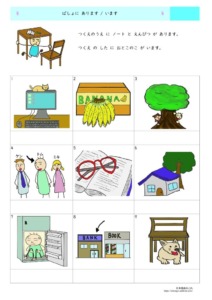

Japanese Grammar Materials: “Arimasu/Imasu" Information Gap
~ya~nado
(Pointing to a student’s desk with few things on it…)
|
Teacher On top of A-san’s desk… There are books and pens.
学生さん |
(Pointing to a student’s desk with many things on it…)
|
Teacher On top of B-san’s desk… There are pens, a cellphone, a book, an eraser, and…
学生さん
Teacher There are pens, a cellphone, a book… It’s a lot. There are things like pens and cellphones. It’s a lot to list everything, so emphasize giving two examples.
Teacher In the classroom… There are things like a clock and a TV.
学生さん |
A to B to C to D to E ga arimasu.
→ A ya C (nado) ga arimasu.