Sponsored Links

新人君
新人君
This is Lesson 11 of “Minna no Nihongo.”
This lesson seems difficult because of the counters.
Yes, the counters covered in this lesson
are just a part of all the counters.
先輩さん
先輩さん
The difficult ones to remember are
“hitotsu, futatsu, mittsu, yottsu, itsutsu…”
You just have to memorize them with determination!!
ベテランさん
ベテランさん
中堅さん
中堅さん
Also, be careful with the sound changes for
“ichinen,” “ikkagetsu,” and so on for “one year,” “one month,” etc.
The goal of Lesson 11 is clear!!
ベテランさん
ベテランさん

Goals of “Minna no Nihongo” Lesson 11

“To use various counters.”
“To say the number of times something happened and the duration of activities.”


Counters (~枚)

(Draw a picture of a person finishing a report on the whiteboard and prompt them to say the sentence)

I finished writing the report.
学生さん
学生さん

(Draw a speech bubble with “3” on the picture of the report)
3… I finished writing the report.
学生さん
学生さん
Teacher
Teacher
I wrote 3 reports.

Point

Check the sounds for 1 to 10.
Make them aware that the “counter” goes before the verb.
Also, remind them that particles do not attach after the “counter.”


Board Writing

レポート を 3まい かきました。
てがみ  を 2まい おくります。
かみ   が 9まい あります。

How Many Sheets (何枚)

(Pointing at the desk)

Teacher
Teacher
Everyone, how many sheets of paper are on the desk?
There are 5 sheets.
学生さん
学生さん

Practice Q&A with flashcards.

Board Writing

Q:つくえ の 上 に かみ が なんまい ありますか。
A:               5まい  あります。

Q:てがみ を なんまい おくりますか。
A:       2まい おくります。

~ Machines (~台)

(Draw a picture of a room with a computer and prompt them to say the sentence)

There is a computer in the room.
学生さん
学生さん

(Add 3 more computers to the drawing)
There are 4 computers in the room…
学生さん
学生さん
Teacher
Teacher
There are 4 computers in the room.

Practice counting cars and other electronic devices using flashcards.
Check the counting for 1 to 10

Board Writing

へや に パソコン が 4だい あります。
わたし は くるま が 2だい あります。

How Many Machines (何台)

(Add a question mark to the previous drawing of the computers)

Teacher
Teacher
How many computers are in the room?
There are 4 computers.
学生さん
学生さん

Practice Q&A with flashcards

Board Writing

Q:へや に パソコン が なんだい あります か。
A:             4だい あります。

Q:Aさん は くるま が なんだい あります か。
A:             2だい あります。

~ People (~人)

(Draw a picture of multiple men and women in a room on the whiteboard)

Teacher
Teacher
There are two men in the room.
There are three women in the room.

(Show a picture of a family structure)
Teacher
Teacher
There are five people in my family.
I have two siblings.

Point

※ It’s more natural to say “There are ~ people in my family” with “です”. “I have ~ siblings” sounds more natural with “います”.
Also, note that “There are ~ people in my family” includes oneself, but “I have ~ siblings” does not include oneself.


Check with picture cards. If time allows, make sentences about the population of countries and their own family structures.
 
Board Writing

へや に おとこのひと が ふたり います。
わたし  の  かぞく は ごにん です。
わたし は きょうだい が ふたり います。

How Many People (何人)

(Draw a question mark on the previous picture of the people in the room)

Teacher
Teacher
How many men are in the room?
There are two men.
学生さん
学生さん
Teacher
Teacher
How many women are in the room?
There are three women.
学生さん
学生さん

Practice asking about the number of people in the actual classroom, family, and siblings.

Board Writing

Q:おとこ の ひと が なんにん います か。
A:           ふたり  います。

Q:おんな の ひと が なんにん います か。
A:           さんにん います。


Hitotsu, Futatsu, Mittsu…

(Draw a picture of a person eating an apple)

Teacher
Teacher
I ate an apple this morning.

(Increase the number of apples)
Teacher
Teacher
I ate three apples.

Check the counting for 1 to 10 and note that “つ” is not added after 10.

Teacher
Teacher
There are desks in the classroom…
There are 11 desks.
学生さん
学生さん
Teacher
Teacher
There are doors in the classroom…
There are two doors.
学生さん
学生さん

Practice with flashcards

Board Writing

りんご を みっつ    たべました。
つくえ が じゅういち  あります。
ドア  が ふたつ    あります。

How Many (いくつ)

(Add a question mark to the previous drawing)

Teacher
Teacher
How many apples did you eat?
I ate two apples.
学生さん
学生さん
Teacher
Teacher
How many desks are there in the classroom?
There are ten desks.
学生さん
学生さん

Practice Q&A with flashcards

Board Writing

Q:りんご を いくつ たべました か。
A:      ふたつ たべました。

Q:つくえ が いくつ あります か。
A:      とお あります。


中堅さん
中堅さん
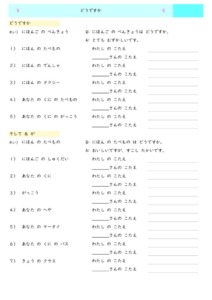
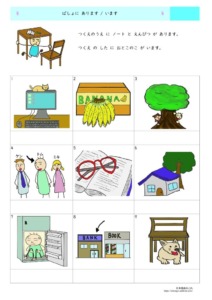
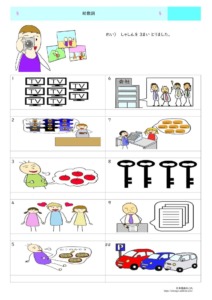
I’ve prepared practice materials here.
First, let’s practice making basic sentences!!

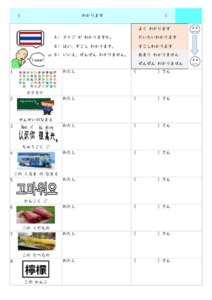
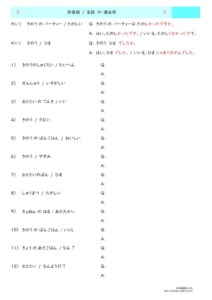
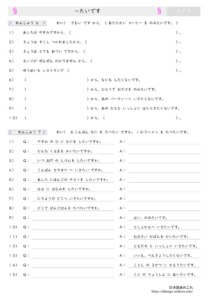
Thumbnail of counter sentences PDF
You can download the materials here


中堅さん
中堅さん
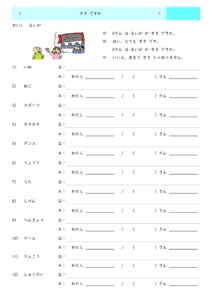
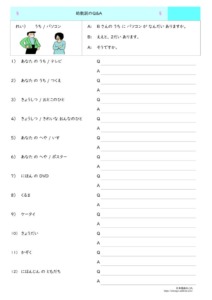
I’ve prepared practice materials here!!
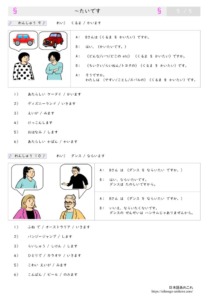
Now let’s practice Q&A

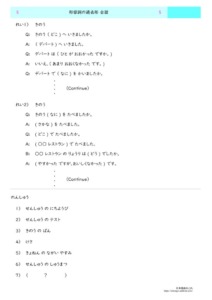
Thumbnail of counter QA PDF
You can download the materials here
 
中堅さん
中堅さん
Let’s stop here.
Please look at the second half later.

新人君
新人君
Lesson 12, right? It’s about the past tense of adjectives, comparative, and superlative forms.

Yes, it’s a relatively easy sentence pattern to understand, and introducing and practicing it is engaging, so this lesson is good.
先輩さん
先輩さん

中堅さん
中堅さん
Past tense of adjectives… Can we get it to stick smoothly?

Since adjectives are studied less frequently compared to verbs, regularly include them in example sentences and teaching materials to make sure students don’t forget them!!
ベテランさん
ベテランさん

Here are the goals for this lesson!!
先輩さん
先輩さん

Goals for Lesson 12 of “Minna no Nihongo”

“Using the past tense of adjectives to talk about impressions and feelings of past events.”
“Using comparative expressions to evaluate things.”


Past Tense of な-Adjectives and Nouns

教師
教師
A-san, are you free tomorrow?

Yes, I am free. / No, I am not free.
学生さん
学生さん

教師
教師
B-san, were you free yesterday?

Yes, I was free?
学生さん
学生さん

教師
教師
Yes, I was free. / No, I was not free.

教師
教師
Everyone, is tomorrow Tuesday?

Yes, it is Tuesday.
学生さん
学生さん

教師
教師
Was yesterday Sunday?

Yes, it was Sunday.
学生さん
学生さん

教師
教師
Was the day before yesterday Friday?

No, it was not Friday.
学生さん
学生さん
Board Notes

(な-Adjectives)
Q: あした ひま ですか。
A: はい ひま です。
 いいえ ひま じゃありません。

Q: きのう ひま でしたか。
A: はい ひま でした。
 いいえ ひま じゃありませんでした。

Practice converting present tense to past tense orally.
(For example: 便利です → 便利でした / 雨じゃありません → 雨じゃありませんでした。)


Past Tense of い-Adjectives

教師
教師
C-san, are you busy tomorrow?

Yes, I am busy. / No, I am not busy.
学生さん
学生さん

教師
教師
D-san, how about yesterday?

Yes, I was busy…
学生さん
学生さん

(Writing transformation rules)

教師
教師
I was busy.

教師
教師
No, I was not busy…

(Writing transformation rules)
教師
教師
I was not busy.


Board Notes

(い-Adjectives)
Q: あした いそがしい ですか。
A: はい いそがしい です。
 いいえ いそがし くないです。

Q: きのう いそがしかった ですか。
A: はい いそがし かった です。
 いいえ いそがしくなかったです。

After confirming the rules, practice converting present tense to past tense orally.

Points

Be careful with 「いいです」→「よかったです」/「よくないです」→「よくなかったです」.
Watch out for mistakes like “暑かったでした” and “おいしくなかったでした”.


中堅さん
中堅さん
I’ve prepared some practice materials here!!

Thumbnail of Adjective Past Tense PDF
Download the materials from here
 

How Was It?

教師
教師
Everyone, how was today’s study?

It was difficult.
It was easy.
It was interesting.
It was tough.
学生さん
学生さん

教師
教師
It was interesting but difficult.

(Remind about the conjunctions “そして” and “が” to connect sentences.)

教師
教師
How was last month’s party?

There were many people. And it was lively.
It was fun, but the food was not good.
Etc.
学生さん
学生さん

Ask various other questions and let the students answer freely.

Points

This unit is just about making sentences in the past tense and connecting them, so it’s an easy unit to understand without much detailed introduction.

 
中堅さん
中堅さん
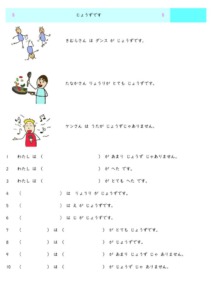
I’ve prepared some practice materials here!!

Thumbnail of How Was It (Adjectives) PDF
Download the materials from here


中堅さん
中堅さん
I’ve also prepared conversation practice materials this time!!

Thumbnail of Adjective Past Tense Conversation PDF
Download the materials from here
 
新人君
新人君
We’re now in the second half. Comparative expressions will come up next.


新人君
新人君
This is lesson 13.
“I want to do ~.” “I’m going to ~.”
These are sentence patterns using the “masu” form.

It’s easy because you just replace “masu” with another word.
先輩さん
先輩さん

中堅さん
中堅さん
Making sentences is easy, but listening to sentences like “mi ni ikimasu” and “shi ni ikimasu” is difficult…

If you emphasize that “~hoshii” and “~tai” are adjectives, it should be fine!
ベテランさん
ベテランさん

新人君
新人君
The negative form of “~tai desu,” “~takunai desu,” seems hard to remember too.

This is the goal for this lesson!!
先輩さん
先輩さん

Goals for Lesson 13 of “Minna no Nihongo”

Communicate what you want or want to do
Communicate the purpose of going somewhere

In this lesson, students will make sentences using “kara” (because) to express reasons, using previously learned sentence patterns and vocabulary. It’s a great review opportunity!!
ベテランさん
ベテランさん
新人君
新人君
You can get the materials on this page.

 Japanese Grammar Materials: “I want to do ~ / I don’t want to do ~”


~が欲しいです。

(Draw a person who looks thirsty on the whiteboard. Draw a speech bubble and a picture of water.)

Teacher
Teacher
I’m thirsty, so I want water.

(Draw a person who looks hungry on the whiteboard…)

Teacher
Teacher
I’m hungry, so…

I want food.
学生さん
学生さん

(Draw various other pictures…)

Teacher
Teacher
I’m lonely, so…

I want a boyfriend.
学生さん
学生さん

Teacher
Teacher
I have a lot of work, so…

I want time.
学生さん
学生さん

Practice with flashcards, creating sentences with given clauses.

~が欲しくないです。

Teacher
Teacher
Everyone, tomorrow is a holiday.
Do you want homework?

No, I don’t want it.
学生さん
学生さん

Teacher
Teacher
“Hoshii” is an “i-adjective.”

No, I don’t want it.
学生さん
学生さん

Practice with other YES/NO questions.

Board Notes

(Noun) が ほしい です。
I want money.
I want time.
I want water.

Q: Do you want a bag?
A: Yes, I want it.
No, I don’t want it.


What do you want?/ What kind of ~ do you want?

Teacher
Teacher
Mr. A, what do you want for your birthday?

I want a shirt.
学生さん
学生さん

Teacher
Teacher
What kind of shirt do you want?

I want a nice shirt.
学生さん
学生さん

Ask other students as well.

Points

Confirm that when answering, “Noun + no + Noun,” “i-adjective + Noun,” and “na-adjective + na + Noun” will appear.


Board Notes

Q: What do you want?
A: I want a shirt.

Q: What kind of shirt do you want?
A: I want a nice shirt. (na-adjective)
I want an expensive shirt. (i-adjective)
I want a Japanese shirt. (Noun)


中堅さん
中堅さん
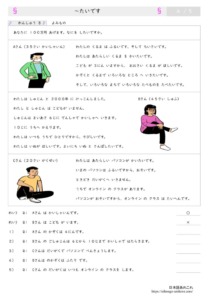
I’ve prepared practice materials here!!

Thumbnail of Lesson 13 13-1 (Want)

~たいです。

Points

If sentences like “nemasu ga hoshii desu” appear in the “I want ~” section, you can introduce this naturally.


(Draw a person who looks like they want to eat cake on the whiteboard)

Teacher
Teacher
I want to eat cake.

(Draw a person pointing at a movie theater)
Teacher
Teacher
I want to watch a movie.

(Draw a person who looks like they want to smoke on the whiteboard)

Teacher
Teacher
I want to smoke…

I want to smoke.
学生さん
学生さん

Practice with flashcards.
Provide a reason (first clause) and practice creating sentences with “~tai” (second clause).
Example: (Head hurts, so…) I want to go home.
(I’m tired, so…) I want to rest.

Board Notes

I want to eat cake.
I want to watch a movie.
I want to smoke.


中堅さん
中堅さん
I’ve prepared practice materials here!!

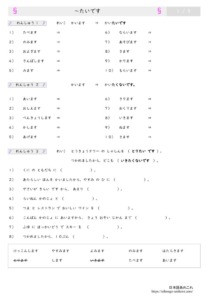
Thumbnail of Thumbnail of
You can download the materials here


What do you want to do? / What kind of ~ do you want to do?

Teacher
Teacher
Mr. A, what do you want to eat tonight?

I want to eat fish.
学生さん
学生さん

Teacher
Teacher
Mr. B, what do you want to do on Sunday?

I want to buy a bag at the department store.
学生さん
学生さん

Teacher
Teacher
What kind of bag do you want to buy?

I want to buy a small bag.
学生さん
学生さん

Introduce this by asking other questions as well.

Board Notes

Q: What do you want to eat?
A: I want to eat fish.

Q: What kind of bag do you want to buy?
A: I want to buy a small bag.

Q: Where do you want to eat lunch?
A: I want to eat at Matsuya.

Q: When do you want to go back to your country?
A: I want to go back in April next year.


~たいです。 / ~たくないです。

Teacher
Teacher
Everyone, do you want to have a party at school tomorrow?

Yes, I do.
学生さん
学生さん

Teacher
Teacher
Do you want to have a test tomorrow?

No, I don’t want…
学生さん
学生さん

Teacher
Teacher
“~tai” is an “i-adjective.”

No, I don’t want to.
学生さん
学生さん

Ask a few more questions to confirm the sentence pattern.

Board Notes

Tomorrow, I want to have a party.
Tomorrow, I don’t want to have a test.

Tonight, I want to drink beer.
Every night, I don’t want to drink beer.


中堅さん
中堅さん
I’ve prepared practice materials here!!

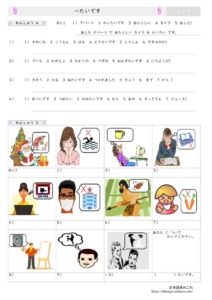
Thumbnail of Thumbnail of Thumbnail of
You can download the materials here

中堅さん
中堅さん
This should be fine for now.

Now, let’s continue to the second half!!
ベテランさん
ベテランさん

新人君
新人君
We’re already on Lesson 14 of “Minna no Nihongo.”
The “te-form” is finally making its appearance.

From this lesson, we’ll be learning various forms consecutively.
先輩さん
先輩さん

中堅さん
中堅さん
Before the “te-form,”
we need to first remember how to divide verbs into groups…
Then, the detailed rules for Group 1…

Don’t worry!
Once you firmly remember the “te-form,” many sentence patterns will be easier to remember!!
Prioritize learning the transformation rules of the forms!
ベテランさん
ベテランさん

中堅さん
中堅さん
The goal of this lesson is…

Goals of “Minna no Nihongo” Lesson 14

“Be able to use expressions for making requests, suggestions, and offers.”
Talk about what you are doing using the present continuous tense.


Introduction to the Present Continuous Tense → Introduction to the Te-form

(Draw a picture on the whiteboard of a person about to eat a meal)

Teacher
Teacher
I am about to eat a meal.
“Itadakimasu”

(Draw a picture on the whiteboard of a person who has finished eating)
Teacher
Teacher
I just ate a meal.
“Gochisosama deshita.”

(Draw a picture between the two of a person in the middle of eating a meal)
Teacher
Teacher
I am eating a meal now.
“Tabemasu” becomes “tabeteimasu”.
“Masu” becomes “teimasu”.

(Draw a picture on the whiteboard of a person drinking water)

Teacher
Teacher
Everyone, this person is…

drinking water.
学生さん
学生さん

Teacher
Teacher
No, that’s wrong.
“Nomiteimasu” is incorrect.
It’s “nondeimasu.”

???
学生さん
学生さん

(Write “nomimasu I” and “tabemasu II” on the whiteboard)

Verb Grouping

Continuing from earlier…

Points

Check the vocabulary list of Lesson 14 together.
Once you confirm that there are I, II, and III groups, let them think about how they are divided by rules.

Teacher
Teacher
“Nomimasu” is Group 1. “Tabemasu” is Group II.
“Suuimasu” is Group I. “Agemasu” is Group II.
Then, how about “Kakimasu”?

It’s Group I.
学生さん
学生さん

Sharp students will notice the rule quickly!!
ベテランさん
ベテランさん
Points

Explain that if the sound before “masu” is
“i”, it’s Group I, “e”, it’s Group II, and “shimasu”, “kimasu” are Group III.

Practice grouping verbs for a while without irregular verbs.

Once they get used to it…

Teacher
Teacher
How about “Mimasu”?

It’s Group I.
学生さん
学生さん

Teacher
Teacher
No, it’s Group II.

Explain that when there is only one sound before “masu”, it is also Group II. (Examples: imasu, nemasu, mimasu, etc.)

Teacher
Teacher
Then, how about “Okimasu”?

It’s Group I!!
学生さん
学生さん

Teacher
Teacher
No, “okimasu” is Group II.

???
学生さん
学生さん
Points

Explain that there are special Group II verbs like “okimasu, karimasu, dekimasu”, etc.

After confirming all the rules, practice grouping with oral or flashcards again

Board Writing

Group I
~「i」+masu   ・・・「nomimasu, ikimasu, asobimasu」

Group II
~「e」+masu   ・・・「tabemasu, akemasu, oshiemasu」
one sound + masu  ・・・「mimasu, nemasu, imasu」
Specials      ・・・「okimasu, karimasu, abimasu, dekimasu, orimasu」

Group III     ・・・「shimasu / kimasu」


中堅さん
中堅さん
I have prepared practice materials here!!

Te-form Rules

(Going back to the “~ています” picture from earlier…)

Teacher
Teacher
“Gohan wo tabemasu.”
“Tabemasu” becomes “tabeteimasu”.
“Tabete” is the “te-form”.

(Draw a picture of a person opening a window)

Teacher
Teacher
The window…

The window is open.
学生さん
学生さん
 
Board Writing

Te-form
Group II / Group III (masu → te)
II tabemasu → tabete
  akemasu → akete
III shimasu  → shite
  kimasu  → kite

Gohan wo tabete + imasu.
Mado  wo akete + imasu.

(Using the picture of drinking water from earlier…)

Teacher
Teacher
Drinking water.

(Draw a picture of a person smoking a cigarette)
Smoking a cigarette.
学生さん
学生さん

Teacher
Teacher
“Sundeimasu” is incorrect.
It’s “sutteimasu.”

Te-form
Group I
i, chi, ri → tte su i  masu   ma chi  mas   kae ri  mas 
           su tte    ma tte    kae tte

ni, mi, bi → nde shi ni  mas   no mi  mas   aso bi  mas 
           shi nde    no nde    aso nde

ki → ite     ka ki  mas   ki ki  mas 
           ka ite    ki ite

gi → ide     oyo gi  mas   iso gi  mas 
           oyo ide    iso ide

shi → shite     hana shi  mas   ka shi  mas 
           hana shite    ka shite

Smoking a cigarette.
Drinking water.
Writing a letter.

Once all the rules are confirmed, practice making te-forms.
After memorizing the te-form, practice sentence patterns using “~teimasu” with flashcards.

中堅さん
中堅さん
I have prepared practice materials here!!

新人君
新人君
Now, in the second half, we will learn sentence patterns using the te-form.

Once you properly memorize the te-form,
it’s easy!!
ベテランさん
ベテランさん

新人君
新人君
Sigh…
This is lesson 15.
It’s difficult to convey the concept of “~ています” in the latter half.

Well, don’t say that,
the first half of this lesson, “~てもいいです。” and “~てはいけません。” are easy to teach.
先輩さん
先輩さん

中堅さん
中堅さん
Indeed, the latter half is complicated.
“~ています” is used in various contexts like “status, continuity, repetition”.

Even Japanese people use it unconsciously, so
it’s difficult for both the teachers and learners to understand!
We need to give examples carefully, one by one, to help understand the situations!!
ベテランさん
ベテランさん

新人君
新人君
The goal of this lesson is…
Let’s see…

Goal of “Lesson 15” in Minna no Nihongo

“To ask for permission and inquire if something is possible.”
“To talk about things you do regularly or about your status.”


~てもいいですか

(Draw a picture on the whiteboard of a person who is feeling hot and holding a remote, asking something to others)

Teacher
Teacher
Everyone, what does this person say?

May I turn on the air conditioner?
Is it okay to turn on the air conditioner?
Student
Student

Teacher
Teacher
What is the “te-form” of “つけます” (to turn on)?

It is “つけて”.
Student
Student

Teacher
Teacher
Yes, you say “エアコンをつけてもいいですか。”

(Draw a picture of a person who is troubled because they don’t have a pen)

Teacher
Teacher
What does this person say?

May I borrow a pen?
Student
Student

Points

※ Some students might mistakenly say “貸してもいいですか。” (May I lend?). Explain that “借りても…” (May I borrow…) should be used for their own actions.

Deepen understanding of sentence patterns using flashcards and practice asking for permission.

Board Writing

エアコン を つけます。 いいですか。
       つけても いいですか。

ボールペン を かります。 いいですか。
       かりても いいですか。

& nbsp;

中堅さん
中堅さん
I’ve prepared practice materials here!!

Thumbnail of Lesson 15, Part 1 (Permission)


Q: ~てもいいですか。(Personal belongings)
A: Sure, go ahead. / Sorry, but…

Teacher
Teacher
Excuse me, A-san.
May I borrow a pencil?

Yes, you may borrow it.
Student
Student

Teacher
Teacher
“Sure, go ahead” is better.

Teacher
Teacher
Excuse me, B-san.
May I borrow 10,000 yen?

No, um… I can’t borrow? Not good?
Student
Student

Teacher
Teacher
Instead of “No”,
“Sorry, but…” is better.
“Sorry, but… I don’t have it now.” is also good.

Teacher
Teacher
Excuse me, C-san.
May I turn off the air conditioner?

Sorry, but…
It’s hot…
Student
Student

Practice various situations with flashcards.
When responding, add reasons to practice sentence construction.

Board Writing

Q: ボールペン を かりてもいいですか。
A: Sure, go ahead.

Q: 10,000 yen かりてもいいですか。
A: Sorry, but…

Q: エアコン を けしてもいいですか。
A: Sorry, it’s hot…


中堅さん
中堅さん
I’ve prepared practice materials here!!

 Thumbnail of Lesson 15, Part 3 (Prohibition) Thumbnail of Lesson 15, Part 4 (Permission/Prohibition)

There’s more material here too!
先輩さん
先輩さん


Q: ~てもいいですか。(Rules)
A: Yes, you may. / No, you may not.

(Draw a picture of a hospital on the whiteboard)

Teacher
Teacher
This is a hospital.
Is it okay to read books in the hospital?

Sure, go ahead.
Student
Student

Teacher
Teacher
Since it’s a hospital rule,
“Yes, you may read” is better.

Teacher
Teacher
Is it okay to smoke in the hospital?

Sorry, but…
Student
Student

Teacher
Teacher
Since it’s a rule.
“Sorry, but…” is not good.
Use “No, you may not smoke.”.
“いけません。” means “No”. (Show the prohibition mark)

Practice “~てはいけません” with flashcards
Practice saying prohibitions by giving place names.
Practice creating appropriate sentences using “~てもいいです” and “~てはいけません” given the reasons.

Board Writing

Q: Can you read a book in the hospital? Yes, you may.

Q: Can you smoke in the hospital?

A: No, you may not.


中堅さん
中堅さん
I’ve prepared practice materials here!!

 Thumbnail of Lesson 15, Part 3 (Prohibition) Thumbnail of Lesson 15, Part 4 (Permission/Prohibition)

There’s more material here too!
先輩さん
先輩さん

 Various materials for teaching Japanese grammar “~てもいいです / ~てはいけません”

中堅さん
中堅さん
This sentence pattern is long and hard to remember…

The latter half is tough too!!
ベテランさん
ベテランさん

新人君
新人君
This is Lesson 16 of Minna no Nihongo.
In this lesson, we will continue learning sentence patterns using the “te-form”.

Everyone seems to be getting better at forming the “te-form”.
先輩さん
先輩さん

中堅さん
中堅さん
Don’t forget that in the latter part, there are sentence patterns for adjectives.
Students might also forget some vocabulary for adjectives…

These are the goals for this lesson!!
ベテランさん
ベテランさん

Goals of Lesson 16 in Minna no Nihongo

“Be able to explain daily actions in sequence”
“Be able to describe things and places by connecting adjectives”


~て、~て

Key Points

Be careful as the difference between “~て、~て” and “~てから” can be difficult to understand.
It’s easier to explain with examples: use “~て~て” for continuous actions, and “~てから” for actions that occur after A finishes and B starts.


(Draw a picture of a vending machine on the whiteboard)
教師
教師
Everyone, you want to buy a juice.
What do you do first?

Insert money.
学生さん
学生さん

教師
教師
You inserted the money.
What do you do next?

Press the button.
学生さん
学生さん

教師
教師
That’s right.
You insert the money and then press the button.

(Draw a picture of a station on the whiteboard)
教師
教師
We are going to take the train now.
What do you do?

Buy a ticket.
学生さん
学生さん

教師
教師
You buy a ticket and then take the train.
Board Writing

おかね を いれて、ボタン を おします。
きっぷ を かって、でんしゃ に のります。


~て、それから・・・

When connecting three actions, pay attention to the position of “sorekara” (then).
先輩さん
先輩さん

(Draw pictures on the whiteboard of brushing teeth, washing face, and a person heading to work with a bit of space in between)
(Encircle the brushing teeth and washing face pictures, then draw an arrow connecting to the picture of the person heading to work)</ p>

教師
教師
What does this person do every morning?

Brushes teeth, washes face, and goes to work.
学生さん
学生さん

教師
教師
That’s right.
At home, he brushes his teeth and washes his face. After that, he goes to work.
“It’s better to say, ‘Brushes teeth, washes face, then goes to work.'”

(Draw a picture of a person withdrawing money at a bank, heading to a supermarket, and buying fish on the whiteboard)

Withdraw money at the bank, go to the supermarket, then buy fish.
学生さん
学生さん

教師
教師
Hmm…
Withdraw money, then go to the supermarket and buy fish.
That sounds better.

(Draw an arrow from the picture of the person withdrawing money to the picture of the person heading to the supermarket and buying fish, encircling the latter two)


中堅さん
中堅さん
I’ve prepared practice materials here!!

それから・・・ → ~てから・・・

(Just replace “sorekara” on the whiteboard with “tekara”)
Practice with flashcards

~て~て VS ~てから(それから)

Explain the difference between “~て、~て” and “sorekara/~てから” to students who haven’t understood it yet.

Board Writing

➀Meet the company’s clientand have dinner.
②Meet the company’s clientthen have dinner.


教師
教師
Are they the same or different?

……
学生さん
学生さん

Key Points

➀ is… (draw a picture on the whiteboard of a client and you having dinner together)
② is… (draw a picture on the whiteboard of finishing the business meeting with the client and having dinner alone)
Other examples,
➀ Go to the bathroom and take a shower. (bathroom and shower are in the same room)
② Go to the bathroom then take a shower. (bathroom and shower are in different rooms)
Explain while drawing such pictures.


中堅さん
中堅さん
I’ve prepared practice materials here!!


~てから何をしますか。(Question)

教師
教師
What do you do after you wake up in the morning?

I eat breakfast.
Brush my teeth.
Go to the bathroom.
学生さん
学生さん

教師
教師
What did you do after you got home yesterday?

I watched TV.
Read a book.
Took a shower.
学生さん
学生さん

教師
教師
What do you want to do after returning to your country?

I want to work at a Japanese company.
I want to eat my mother’s cooking.
I want to meet my friends.
学生さん
学生さん
中堅さん
中堅さん
Now, let’s write an essay…

 
There are more materials here!!
ベテランさん
ベテランさん
 

How to (Steps)

(Draw a picture of an ATM on the whiteboard)

教師
教師
This is an ATM.
How do you use it?

(Make sentences step by step by asking students to provide the steps)

Board Writing
  1. First, insert the card.
  2. Enter the PIN.
  3. Enter the amount.
  4. Take the money.
  5. Take the card.
  6. Take the receipt.

First, insert the card,
next, enter the PIN,
enter the amount,
then take the money,
take the card,
take the receipt.

Other examples:
How to use a microwave.
How to make cup noodles.
How to get to ~ (train transfers).
How to get home.
Try making various sentences.

中堅さん
中堅さん
That’s it for today…
We’ll continue next time.


新人君
新人君
I’m so nervous about my first student lesson…

Yes.
I’ve handled new classes many times before,
but I never get used to it…
Every time, I get so nervous I can’t sleep…
先輩さん
先輩さん

新人君
新人君
I wonder what kind of students I’ll have?
How will the class atmosphere be?
Will I be able to get along with everyone?
Ah, I’m so worried I can’t sleep tonight either…

Why are you making such a fuss?
The first class?
Everyone gets nervous about that!
However, there are a few things you should do in the first class…
Veteran
Veteran

新人君
新人君
Wh-what are they?
Please, tell me.

First, you should prioritize creating a good class atmosphere!!
Veteran
Veteran

If the teacher is tense and has a stiff expression during the lesson,
the students won’t be able to feel relaxed.
From the first lesson, conduct the class brightly and energetically.

Then, make sure the students understand your instructions!!
Veteran
Veteran

You will give instructions for repeating, chorusing, or speaking individually,
but if they don’t understand these instructions early on, the class won’t proceed smoothly.
It’s also difficult to explain how to do conversation practice or worksheets each time.
Initially, prepare somewhat standardized materials
so that students can work smoothly.
Once they get used to learning Japanese and understand instructions in Japanese,
you can prepare various types of materials.

中堅さん
中堅さん
When the repeat signal doesn’t get through,
no one repeats…
Silence…
Loneliness…
It’s scary.

ーーーーーーーーーーーーーーーーーーーーーーーーーーーーーーーーーーーー
Confirm the class rules!!
Veteran
Veteran

Classroom rules vary by country.
For example, no chewing gum,
no wearing hats in the classroom,
no freely going to the bathroom,
and so on…
If you don’t teach the rules for the Japanese class early on,
it will become difficult and troublesome to convey them later.

中堅さん
中堅さん
It’s easy to convey rules to students at first,
but it becomes harder as the class progresses.
Students might wonder why something that was okay before isn’t okay now…

ーーーーーーーーーーーーーーーーーーーーーーーーーーーーーーーーーーー
Make it a habit to submit homework and take notes!!
Veteran
Veteran

Check these things strictly from the beginning.
Homework must be submitted.
Write in your notebook,
and don’t scribble in the textbook.
Make these habits from the start.

Find the mood maker , the teased character, and the beloved character!!
Veteran
Veteran

This is also very important.
If you have such students in your class,
the class will naturally become more lively or calm,
making it much easier to manage in the future.

If you can’t find such students…
You could try gently teasing someone to create a teased character or a beloved character…
But this method is risky…
If you tease someone who doesn’t like it, you might end up hurting them…
先輩さん
先輩さん

ーーーーーーーーーーーーーーーーーーーーーーーーーーーーーーーー
Deepen the connections between students early on!!
Veteran
Veteran

At first, even if you have to force it, try to incorporate a lot of pair work and group work.
Increase opportunities for students to talk and teach each other.
When connections between students are formed,
students who are good at the subject will naturally start supporting those who struggle.

At the beginner level, you see students teaching each other answers in their native language during pair work…
It’s better to have more students who can teach their friends and raise the overall class level,
rather than leaving anyone behind.
先輩さん
先輩さん

Keep these things in mind while managing the initial classes.
Good luck!!
Veteran
Veteran