Sponsored Links

新人君
新人君
ハックション!!

大きいくしゃみね。
どうしたの?風邪でもひいたの?
先輩さん
先輩さん

新人君
新人君
ええ、今朝からくしゃみが止まらなくて…
昨日の雨、ザーザー凄かったじゃないですか。

そうだな。
確かに昨日の雨はすごかったな。
我が家の犬たちもブルブル震えてたな。
ベテランさん
ベテランさん

中堅さん
中堅さん
ちゃんと体調管理をしないとダメよ!!
最近はみんな敏感だから熱を出したり、咳をしたりするだけでもイヤな雰囲気になるんだから。

そうだな。
ツライ世の中になったもんだ…
ベテランさん
ベテランさん


カタカナ言葉

教師
教師
みなさん、どんな時にカタカナを使いますか。

外国語の音の日本語に使います。
レストランの名前に使います。
雨とか車の走る音に使います。
学生さん
学生さん

教師
教師
そうですね。
色々なときにカタカナを使いますね。

Point

When to Use Katakana

  • Foreign Words: (アイスクリーム, ホッチキス, ラーメン, etc.)
  • Onomatopoeia: (ゴロゴロ, ザーザー, トントン, etc.)
  • Mimetic Words: (キラキラ, ザラザラ, ニコニコ, etc.)
  • Names of Living Creatures: (イヌ, カバ, ウサギ, etc.)
  • To Distinguish Specific Words: (ゴミ, みえないチカラ, がんばれニッポン, etc.)
  • To Emphasize Words in Sentences: (ボケる, ボケとツッコミ, オトンとオカン)

And so on.


Dictation

① ニューヨーク

② ロボット

③ ファイル

④ ユーモア

⑤ マクドナルド

⑥ バスケットボール

⑦ サンドイッチ

⑧ スパゲッティ

⑨ ホッチキス

⑩ レントゲン

など

拗音や促音が入っているもの
英語由来だが、英語の発音と遠いもの
由来が英語以外の物などを中心に出題する

新人君
新人君
あれ?
このドア… (Huh? This door…)

どうしたの? (What’s wrong?)
先輩さん
先輩さん

新人君
新人君
このドア、
開けようとしても開かないんです。 (This door, even if I try to open it, it won’t open.)

そういえば、このドア一度も開けたことないな…
いつも物が前に置いてあるから、開けようとも思わなかったな。 (Come to think of it, I’ve never opened this door… There’s always stuff in front of it, so I never thought to open it.)
ベテランさん
ベテランさん

中堅さん
中堅さん
普段から使われていないドアなんて、
どこにでもあるじゃない…
気にしないほうがいいんじゃない? (There are doors that aren’t used all the time everywhere… Maybe you shouldn’t worry about it?)

何か気になるわね… (Something’s bothering me…)
先輩さん
先輩さん

新人君
新人君
忘れろと言われると、
逆に忘れようとしても忘れられなくなりますね… (When you’re told to forget, it makes you unable to forget even if you try…)

~意向形+としても+自動詞(-)

教師
教師
暑いですから、窓を開けます。
あれ、この窓…開きません。
頑張って窓を開けます。でも開きません。
窓を開けようとしても、開きません。 (It’s hot, so I’ll open the window. Huh, this window… It won’t open. I’ll try hard to open the window. But it won’t open. Even if I try to open the window, it won’t open.)

教師
教師
窓は開けようとしても開きませんから、エアコンをつけます。
このリモコンで…
あれ、このリモコンが変です。
エアコンをつけようとしても、つきません。 (Even if I try to open the window, it won’t open, so I’ll turn on the air conditioner. With this remote… Huh, this remote is weird. Even if I try to turn on the air conditioner, it won’t turn on.)

Point

意向形を忘れている可能性があるので確認する。
また、この文型は他動詞と自動詞を使うので、文型の学習の前に自他動詞について確認する。
(Confirm the volitional form as it may have been forgotten. Also, since this sentence pattern uses transitive and intransitive verbs, confirm transitive and intransitive verbs before learning the sentence pattern.)


Chalkboard writing

(意向形)と しても 自動詞 (-) (Volitional form + としても + intransitive verb (-)
開けよう と しても 開きません。
つけよう と しても つきません。
開けよう と しても 開きません。
つけよう と しても つきません。)


Practice

例 電気をつけます。 → (電気をつけようとしても、つきません。)
(Example: I’ll turn on the light. → (Even if I try to turn on the light, it won’t turn on.)

① 電気をけします。 → (                  )
(I’ll turn off the light. → (                  )

② お金を入れます。 → (                  )
(I’ll put in money. → (                  )

③ 荷物を出します。 → (                  )
(I’ll take out the luggage. → (                  )

④ ボタンを外します。 → (                  )
(I’ll unbutton. → (                  )

⑤ 木を倒します。 → (                  )
(I’ll knock down the tree. → (                  )

⑥ かぎをかけます。 → (                  )
(I’ll lock it. → (                  )

⑦ 窓を開けます。 → (                  )
(I’ll open the window. → (                  )

⑧ 子供を起こします。 → (                  )
(I’ll wake up the child. → (                  )

⑨ 味を変えます。 → (                  )
(I’ll change the taste. → (                  )

⑩ 気持ちを伝えます。 → (                  )
(I’ll convey my feelings. → (                  )


~意向形+としても+可能形(-)

教師
教師
みなさんは嫌いな食べ物がありますか。
わたしはブロッコリーが嫌いです。
頑張って食べますが。口に入れると気持ち悪くなります。
ブロッコリーを食べようとしても、食べられません。 (Do you all have any foods you dislike? I dislike broccoli. I try hard to eat it, but when I put it in my mouth, I feel sick. Even if I try to eat broccoli, I can’t.)

教師
教師
今から漢字を覚えます。
今日は頑張って100個漢字を覚えましょう。
みなさん覚えられますか。 (Now, let’s learn kanji. Let’s try to learn 100 kanji today. Can you all do it?)

いいえ、覚えようとしても、覚えられません。 (No, even if I try to learn, I can’t.)
学生さん
学生さん
Point

開けようとしても、開かない。(おそらく窓に問題がある。)
開けようとしても、開けられない。(窓が重くて、たぶん自分の力が不足している)
(Even if I try to open it, it won’t open. (There is probably a problem with the window.)
Even if I try to open it, I can’t open it. (The window is heavy and probably my strength is not enough.)


Chalkboard writing

(意向形)と しても 可能形 (-) (Volitional form + としても + potential form (-)
食べよう と しても 食べられません。
覚えよう と しても 覚えられません。

食べよう と しても 食べられません。
覚えよう と しても 覚えられません。)


Practice

例 このかばんは重くて、(持とうとしても持てません。)
(Example: This bag is heavy, (Even if I try to carry it, I can’t.))

① とても眠くて、(                )。
(I’m very sleepy, (                ).

② この料理は辛くて、(                )。
(This dish is spicy, (                ).

③ のどが痛いので(                )。
(My throat hurts, so (                ).

④ 寝る前にコーヒーを飲んでしまったので、(                )。
(I drank coffee before going to bed, (                ).

⑤ 先月 別れた彼女のことを(                )。
(About the girlfriend I broke up with last month, (                ).

⑥ ダイエットを頑張っていますが、(               )。
(I’m trying hard to diet, (               ).

⑦ 足が痛くて(              )。
(My leg hurts, (              ).

⑧ 太ってしまいましたから(                )。
(I gained weight, so (                ).

⑨ 力がありませんから、(                )。
(I have no strength, so (                ).

⑩ この薬は苦いので(                )。
(This medicine is bitter, so (                ).

この課のポイントは「意向形」と「自動詞」だな… (The key points of this lesson are “volitional form” and “intransitive verbs”…)
ベテランさん
ベテランさん

新人君
新人君
すみません。
この文型なんですが、どうやって教えたらいいのでしょうか。

うーん、
すぐに人に聞くのではなくて、
自分で文法について本なんかで勉強したほうがいいぞ。
今後のためにも…
ベテランさん
ベテランさん

新人君
新人君
どこで日本語の本を売っているのでしょうか。
どの本が便利なのでしょうか。
いくらぐらいなのでしょうか。

質問の仕方は丁寧だけど、
自分で調べようという気は全然ないのね…
先輩さん
先輩さん

中堅さん
中堅さん
今回は丁寧な疑問文の作り方ね・・・
まあ、私は使わないけど…

~のでしょうか

教師
教師
明日は学校の遠足です。
新橋駅に集まってください。
何か遠足について質問がありますか。

何時に集まればいいですか。
新橋までどうやって行きますか。
お金はいくら必要ですか。
学生さん
学生さん

教師
教師
もう少し丁寧に質問ができますか。

何時に集まればよろしいですか。
どうやって新橋まで参りますか。
学生さん
学生さん

教師
教師
うーん、それは敬語です。
今日は敬語ではなくて、丁寧な言い方を勉強します。
「~のでしょうか。」を使います。

何時に集まればいいのでしょうか。
どうやって行くのでしょうか。
お金はいくら必要のでしょうか。
学生さん
学生さん

教師
教師
な形容詞と名詞は「~なのでしょうか」ですよ。

お金はいくら必要なのでしょうか。
学生さん
学生さん

他にも色々な状況を与えて、自由に質問を作らせる。

Chalkboard writing

(ふつうけい) + のでしょうか。

何時に集まればいい  のでしょうか。
どうやって 行く   のでしょうか。
いくら必要     のでしょうか。(な 形容詞)
昼ご飯はどこのレストラン のでしょうか。(名詞)


Practice

今度 社員旅行があります。 色々と質問してください。
例) 何時に・・・? → (何時に出発するのでしょうか?)

1) 何人・・・? → (               )

2) どこへ・・・? → (               )

3) いつ・・・? → (               )

4) どうやって・・・・ → (               )

5) いくら・・・? → (               )

6) ホテルは・・・? → (               )

明日の会議の準備をしています。 色々質問してください。
1) 場所 → (               )

2) 時間 → (               )

3) 人数 → (               )

4) 資料 → (               )

5) 内容 → (               )

6) 参加者 → (               )

まあ、この文型は生活であまり使わない人もいるな。
ベテランさん
ベテランさん

新人君
新人君
明日、出張で東京へ行くんですよ。

東京といえば浅草だな!
人形焼きを買ってきてくれ!!
ベテランさん
ベテランさん

中堅さん
中堅さん
東京といえば、秋葉原ね…
あとで買い物のリストを渡すわ…

うーん、東京といえば…
ほら、池袋じゃないかしら?
大きい本屋もあって、日本語の教材も買えるわよ。
先輩さん
先輩さん

新人君
新人君
あのう…
旅行じゃなくて、出張なんですけど…

今回は「~といえば」の使い方を確認しよう!!
ベテランさん
ベテランさん

(名詞)といえば(名詞)です

教師
教師
来週、海外から友達が来ます。
有名な観光地へ行きたいんですが、どこがいいですか。

お台場がいいですよ。
学生さん
学生さん

教師
教師
そうですね。
有名な観光地と言えば、お台場ですね。

教師
教師
友達に日本料理を紹介したいんですが、何がいいですか。

寿司がいいです。
学生さん
学生さん

教師
教師
ああ、日本料理といえば、
寿司ですね。

教師
教師
「~といえば」は有名な物、みんなが知っているもの、代表的なものを言うときに使います。

Chalkboard writing

有名な観光地 といえば スカイツリー です。
            お台場    です。
            日光     です。

日本料理   といえば すし     です、
            てんぷら   です。
            すきやき   です。


(~こと)といえば(~こと)です。

教師
教師
明日は試験ですね。
今晩何をしますか。

復習をします。
学生さん
学生さん

教師
教師
週末に何をしますか。

映画を見に行きます。
学生さん
学生さん

Chalkboard writing

試験の前にすること といえば 復習           です。
               友達にノートを借りること です。

週末にすること   といえば 映画を見に行く   こと です。
               友達と買い物へ行く こと です。
               部屋 の 掃除      です。


教師
教師
日本の生活で何が大変ですか。

電車の種類が多いです。
英語の表示が少ないです。
駅の中が複雑です。
学生さん
学生さん

教師
教師
日本の生活で何が楽しいですか。

食べ物を食べます。
遊園地に行きます。
観光地が多いです。
学生さん
学生さん

Chalkboard writing

日本の生活で大変なこと といえば 電車の種類が多い  こと です。
                 英語の表示が少ない こと です。
                 駅の中が複雑な   こと です。

日本の生活で楽しいこと といえば 食べ物を食べる   こと です。
                 遊園地へ行く    こと です。
                 観光地が多い    こと です。

「こと」を使って名詞句にするのがポイントだな!
ベテランさん
ベテランさん

Access to grammar materials

中堅さん
中堅さん
I’ve prepared some practice materials here!!


1課 ~と言えばのサムネイル  1課 ~と言えば2のサムネイル

If you would like to use this material, please click here(2枚組 300円)


あ、あの雲。
まるで羊のようね。
先輩さん
先輩さん

新人君
新人君
そうですか。
僕には綿菓子のようにおいしそうに見えるんですが…

中堅さん
中堅さん
雲を見て、そんなことを言って子供のような人たちね。

今日は比喩表現の教え方についておさらいするぞ!!
ベテランさん
ベテランさん


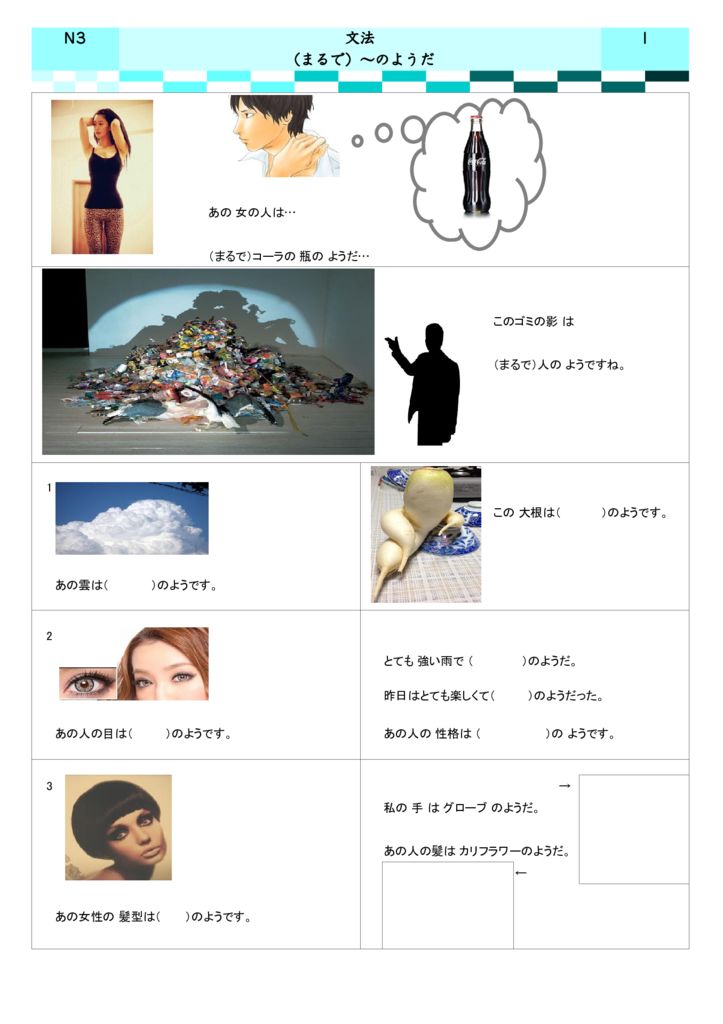
~のようです

(Put a picture of a ningyo-yaki on the whiteboard)

教師
教師
このお菓子は人の顔のようです。

(Teacher draws a picture of what is happening on the whiteboard)
教師
教師
あの先生は怒ると、鬼のようです。

Chalkboard writing

(名詞)のようです。
人の顔 の ようです。
鬼   の ようです。
天使  の ようです。

The phrase “(名詞)のようです” is used to make comparisons, indicating that something resembles or appears to be like the noun mentioned. Here are the examples provided:

  1. 人の顔のようです。

    • It looks like a human face.
  2. 鬼のようです。

    • It looks like a demon.
  3. 天使のようです。

    • It looks like an angel.

In each sentence, “のようです” is used to express that something appears similar to the respective noun.


中堅さん
中堅さん
I’ve prepared some practice materials here.

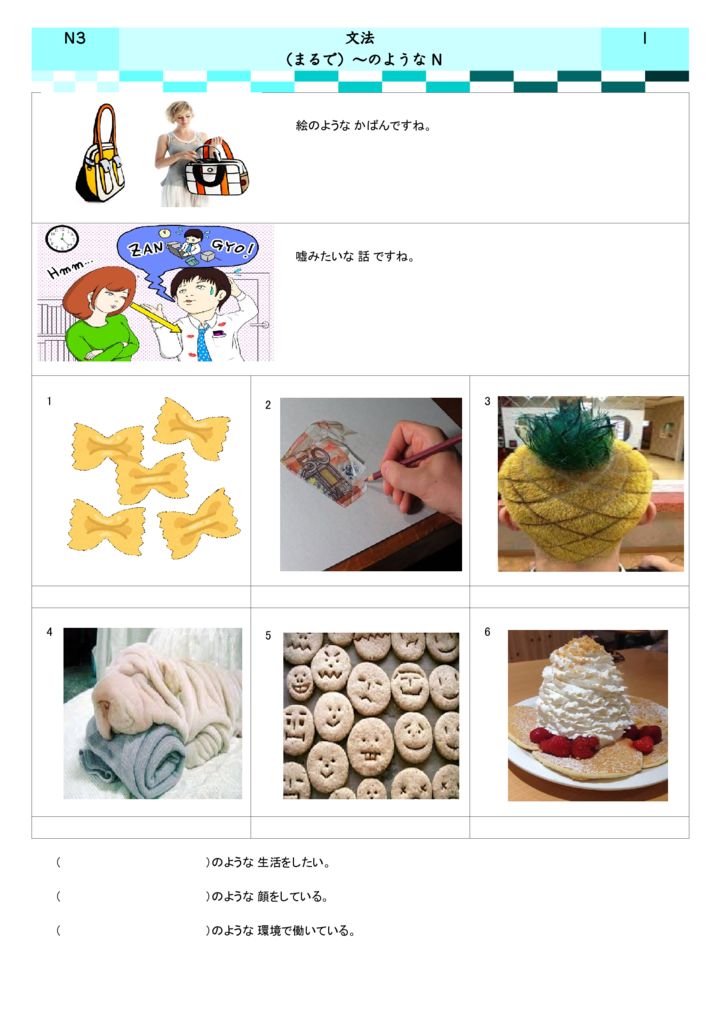
N3 Nのようだ newのサムネイル

~のような+名詞

(Use the photo of the ningyo-yaki from earlier.)

教師
教師
これは人の顔のようなお菓子です。

(Painting a picture of heavy rain)
教師
教師
滝のような雨が降っています。

Chalkboard writing

(名詞)のような(名詞)
人の顔 のような お菓子
滝   のような 雨
子供  のような 人
夢   のような 一日

The phrase “(名詞)のような(名詞)” is used to compare one noun to another, indicating that the second noun resembles or has the qualities of the first noun. Here are the examples provided:

  1. 人の顔のようなお菓子

    • Candy that looks like a human face
  2. 滝のような雨

    • Rain like a waterfall
  3. 子供のような人

    • A person like a child
  4. 夢のような一日

    • A day like a dream

In each example, “のような” is used to describe the second noun as being similar to or having qualities like the first noun.


中堅さん
中堅さん
I’ve prepared some practice materials here.

N3 Nのようなのサムネイル


~のように+動詞・形容詞

(Use the photo of the ningyo-yaki from earlier.)
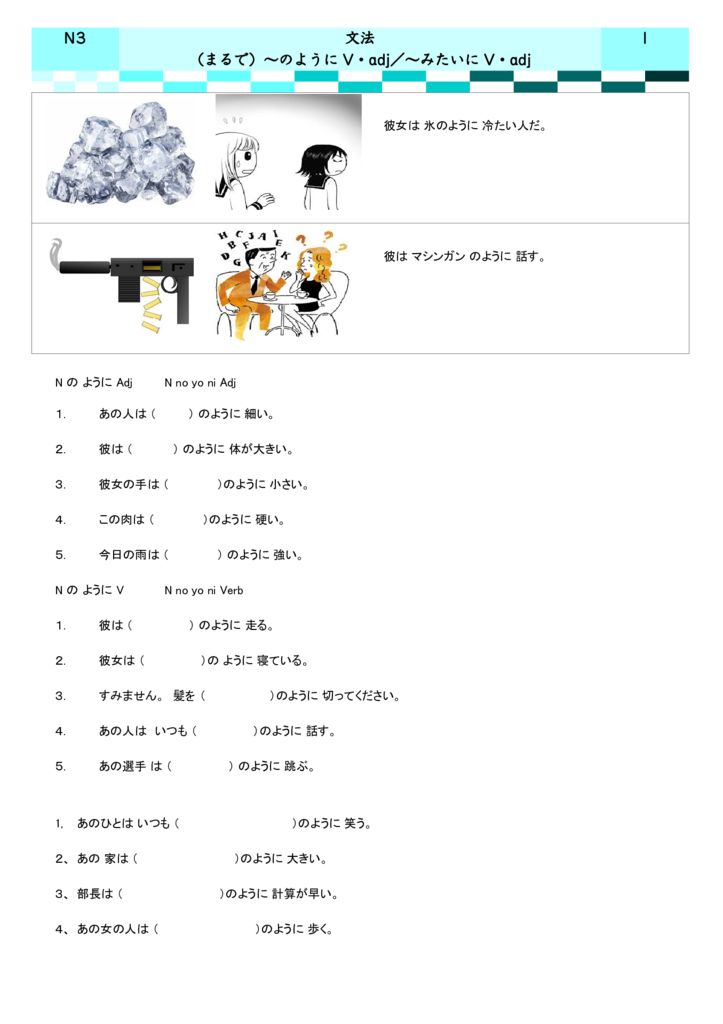
このお菓子はケーキのように甘いです。
あの人はお菓子を豚のように食べています。
(Draw a picture of a sleeping person)
彼女は子供のように寝ています。
彼女が寝ているので、部屋は図書館のように静かです。

Chalkboard writing

ように+形容詞
夜 のように 暗いです。
石 のように 硬いです。

ように+動詞
子供  のように 寝ています。
雨が滝 のように 降ります。

The structure “ように+形容詞” is used to describe something by comparing it to another noun, indicating that it has the same qualities as the noun. The structure “ように+動詞” is used to describe an action by comparing it to another noun, indicating that the action is performed in a manner similar to the noun. Here are the examples provided:

ように + 形容詞

  1. 夜のように暗いです。

    • It is as dark as night.
  2. 石のように硬いです。

    • It is as hard as a stone.

ように + 動詞

  1. 子供のように寝ています。

    • Sleeping like a child.
  2. 雨が滝のように降ります。

    • The rain is falling like a waterfall.

In each example, “ように” is used to make comparisons, describing the quality or manner of something by likening it to another noun.


中堅さん
中堅さん
I’ve prepared some practice materials here.

N3 Nのようにのサムネイル


Practice

例 あの 人は 機械 ( のように )働きます。

① 今日は 夢(     )1日だった。

② 私の父は山(      )体が大きい。

③ 彼は子供(      )嘘をついた。

④ この会社は 環境がよくて 楽園(       )。

⑤ 歩き疲れて 足が 鉄(      )重い。

⑥ 父は ビールを 水(       )飲む。

⑦ 彼女の顔は 人形(      )。

⑧ 彼女の料理は プロの料理(       )おいしさだった。

⑨ 本当に楽しくて 1日がまるで 1時間(       )感じられた。

⑩ 部長は おに(       )顔をしておこっている。


中堅さん
中堅さん
最近、ベテランの先生が私に「もう少し笑う」ように言ったの。

新人君
新人君
僕には「緊張しないでクラスをする」ように言いましたよ。

明日 会議があるから「資料を読む」ように言われちゃった。
先輩さん
先輩さん

ここでは「指示」「助言」などを引用するときに使う「~ように言います」を勉強するぞ!!
ベテランさん
ベテランさん

~ようにしてください。
~ようにします。
~ように言いました。

教師
教師
みなさんのルームメイトはいつも電気を消さないで出かけてしまいます。
友達に何と言いますか。

「電気を消して」と言います。
学生さん
学生さん

教師
教師
はい、いいですね。
でも、他の言い方があります。
「電気を消す」ように言います。
です。

教師
教師
みなさんは子供のときに両親に何と言われましたか。

きちんと勉強するように言われました。
学生さん
学生さん

Chalkboard writing

部長:会議のときは、パソコンを持ってくるようにしてください。
社員A:わかりました。必ず持ってくるようにします。

社員A:部長が「会議のときにパソコンを持ってくる」ように言いました。
社員B:そうですか。わかりました。忘れないようにします。

動詞(辞書形・ない形)+ ように言います。

モノづくり先輩
モノづくり先輩
この教材使ってみてよ…

N3 ように言います。のサムネイル


新人君
新人君
I’m so nervous about my first student lesson…

Yes.
I’ve handled new classes many times before,
but I never get used to it…
Every time, I get so nervous I can’t sleep…
先輩さん
先輩さん

新人君
新人君
I wonder what kind of students I’ll have?
How will the class atmosphere be?
Will I be able to get along with everyone?
Ah, I’m so worried I can’t sleep tonight either…

Why are you making such a fuss?
The first class?
Everyone gets nervous about that!
However, there are a few things you should do in the first class…
Veteran
Veteran

新人君
新人君
Wh-what are they?
Please, tell me.

First, you should prioritize creating a good class atmosphere!!
Veteran
Veteran

If the teacher is tense and has a stiff expression during the lesson,
the students won’t be able to feel relaxed.
From the first lesson, conduct the class brightly and energetically.

Then, make sure the students understand your instructions!!
Veteran
Veteran

You will give instructions for repeating, chorusing, or speaking individually,
but if they don’t understand these instructions early on, the class won’t proceed smoothly.
It’s also difficult to explain how to do conversation practice or worksheets each time.
Initially, prepare somewhat standardized materials
so that students can work smoothly.
Once they get used to learning Japanese and understand instructions in Japanese,
you can prepare various types of materials.

中堅さん
中堅さん
When the repeat signal doesn’t get through,
no one repeats…
Silence…
Loneliness…
It’s scary.

ーーーーーーーーーーーーーーーーーーーーーーーーーーーーーーーーーーーー
Confirm the class rules!!
Veteran
Veteran

Classroom rules vary by country.
For example, no chewing gum,
no wearing hats in the classroom,
no freely going to the bathroom,
and so on…
If you don’t teach the rules for the Japanese class early on,
it will become difficult and troublesome to convey them later.

中堅さん
中堅さん
It’s easy to convey rules to students at first,
but it becomes harder as the class progresses.
Students might wonder why something that was okay before isn’t okay now…

ーーーーーーーーーーーーーーーーーーーーーーーーーーーーーーーーーーー
Make it a habit to submit homework and take notes!!
Veteran
Veteran

Check these things strictly from the beginning.
Homework must be submitted.
Write in your notebook,
and don’t scribble in the textbook.
Make these habits from the start.

Find the mood maker , the teased character, and the beloved character!!
Veteran
Veteran

This is also very important.
If you have such students in your class,
the class will naturally become more lively or calm,
making it much easier to manage in the future.

If you can’t find such students…
You could try gently teasing someone to create a teased character or a beloved character…
But this method is risky…
If you tease someone who doesn’t like it, you might end up hurting them…
先輩さん
先輩さん

ーーーーーーーーーーーーーーーーーーーーーーーーーーーーーーーー
Deepen the connections between students early on!!
Veteran
Veteran

At first, even if you have to force it, try to incorporate a lot of pair work and group work.
Increase opportunities for students to talk and teach each other.
When connections between students are formed,
students who are good at the subject will naturally start supporting those who struggle.

At the beginner level, you see students teaching each other answers in their native language during pair work…
It’s better to have more students who can teach their friends and raise the overall class level,
rather than leaving anyone behind.
先輩さん
先輩さん

Keep these things in mind while managing the initial classes.
Good luck!!
Veteran
Veteran