
Sponsored Links

新人君
新人君
Lesson 12, right? It’s about the past tense of adjectives, comparative, and superlative forms.

Yes, it’s a relatively easy sentence pattern to understand, and introducing and practicing it is engaging, so this lesson is good.
先輩さん
先輩さん

中堅さん
中堅さん
Past tense of adjectives… Can we get it to stick smoothly?

Since adjectives are studied less frequently compared to verbs, regularly include them in example sentences and teaching materials to make sure students don’t forget them!!
ベテランさん
ベテランさん

Here are the goals for this lesson!!
先輩さん
先輩さん

Goals for Lesson 12 of “Minna no Nihongo”

“Using the past tense of adjectives to talk about impressions and feelings of past events.”
“Using comparative expressions to evaluate things.”


Past Tense of な-Adjectives and Nouns
教師
教師
A-san, are you free tomorrow?

Yes, I am free. / No, I am not free.

学生さん
学生さん

教師
教師
B-san, were you free yesterday?

Yes, I was free?
学生さん
学生さん

教師
教師
Yes, I was free. / No, I was not free.

教師
教師
Everyone, is tomorrow Tuesday?

Yes, it is Tuesday.
学生さん
学生さん

教師
教師
Was yesterday Sunday?

Yes, it was Sunday.
学生さん
学生さん

教師
教師
Was the day before yesterday Friday?

No, it was not Friday.
学生さん
学生さん
Board Notes

(な-Adjectives)
Q: あした ひま ですか。
A: はい ひま です。
 いいえ ひま じゃありません。

Q: きのう ひま でしたか。
A: はい ひま でした。
 いいえ ひま じゃありませんでした。

Practice converting present tense to past tense orally.
(For example: 便利です → 便利でした / 雨じゃありません → 雨じゃありませんでした。)


Past Tense of い-Adjectives

教師
教師
C-san, are you busy tomorrow?

Yes, I am busy. / No, I am not busy.
学生さん
学生さん

教師
教師
D-san, how about yesterday?

Yes, I was busy…
学生さん
学生さん

(Writing transformation rules)

教師
教師
I was busy.

教師
教師
No, I was not busy…

(Writing transformation rules)
教師
教師
I was not busy.


Board Notes

(い-Adjectives)
Q: あした いそがしい ですか。
A: はい いそがしい です。
 いいえ いそがし くないです。

Q: きのう いそがしかった ですか。
A: はい いそがし かった です。
 いいえ いそがしくなかったです。

After confirming the rules, practice converting present tense to past tense orally.

Points

Be careful with 「いいです」→「よかったです」/「よくないです」→「よくなかったです」.
Watch out for mistakes like “暑かったでした” and “おいしくなかったでした”.
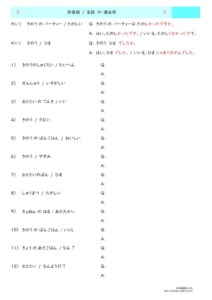
 

中堅さん
中堅さん
I’ve prepared some practice materials here!!

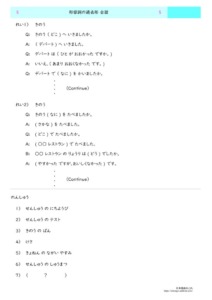
Thumbnail of Adjective Past Tense PDF
Download the materials from here
 

How Was It?

教師
教師
Everyone, how was today’s study?

It was difficult.
It was easy.
It was interesting.
It was tough.
学生さん
学生さん

教師
教師
It was interesting but difficult.

(Remind about the conjunctions “そして” and “が” to connect sentences.)

教師
教師
How was last month’s party?

There were many people. And it was lively.
It was fun, but the food was not good.
Etc.
学生さん
学生さん

Ask various other questions and let the students answer freely.

Points

This unit is just about making sentences in the past tense and connecting them, so it’s an easy unit to understand without much detailed introduction.

 
中堅さん
中堅さん
I’ve prepared some practice materials here!!

Thumbnail of How Was It (Adjectives) PDF
Download the materials from here


中堅さん
中堅さん
I’ve also prepared conversation practice materials this time!!

Thumbnail of Adjective Past Tense Conversation PDF
Download the materials from here
 
新人君
新人君
We’re now in the second half. Comparative expressions will come up next.


新人君
新人君
This is Lesson 11 of “Minna no Nihongo.”
This lesson seems difficult because of the counters.

Yes, the counters covered in this lesson
are just a part of all the counters.
先輩さん
先輩さん

The difficult ones to remember are
“hitotsu, futatsu, mittsu, yottsu, itsutsu…”
You just have to memorize them with determination!!
ベテランさん
ベテランさん

中堅さん
中堅さん
Also, be careful with the sound changes for
“ichinen,” “ikkagetsu,” and so on for “one year,” “one month,” etc.

The goal of Lesson 11 is clear!!
ベテランさん
ベテランさん

Goals of “Minna no Nihongo” Lesson 11

“To use various counters.”
“To say the number of times something happened and the duration of activities.”


Counters (~枚)

(Draw a picture of a person finishing a report on the whiteboard and prompt them to say the sentence)

I finished writing the report.
学生さん
学生さん

(Draw a speech bubble with “3” on the picture of the report)
3… I finished writing the report.
学生さん
学生さん

Teacher
Teacher
I wrote 3 reports.

Point

Check the sounds for 1 to 10.
Make them aware that the “counter” goes before the verb.
Also, remind them that particles do not attach after the “counter.”


Board Writing

レポート を 3まい かきました。
てがみ  を 2まい おくります。
かみ   が 9まい あります。

How Many Sheets (何枚)

(Pointing at the desk)

Teacher
Teacher
Everyone, how many sheets of paper are on the desk?

There are 5 sheets.
学生さん
学生さん

Practice Q&A with flashcards.

Board Writing

Q:つくえ の 上 に かみ が なんまい ありますか。
A:               5まい  あります。

Q:てがみ を なんまい おくりますか。
A:       2まい おくります。

~ Machines (~台)

(Draw a picture of a room with a computer and prompt them to say the sentence)

There is a computer in the room.
学生さん
学生さん

(Add 3 more computers to the drawing)
There are 4 computers in the room…
学生さん
学生さん

Teacher
Teacher
There are 4 computers in the room.

Practice counting cars and other electronic devices using flashcards.
Check the counting for 1 to 10

Board Writing

へや に パソコン が 4だい あります。
わたし は くるま が 2だい あります。

How Many Machines (何台)

(Add a question mark to the previous drawing of the computers)

Teacher
Teacher
How many computers are in the room?

There are 4 computers.
学生さん
学生さん

Practice Q&A with flashcards

Board Writing

Q:へや に パソコン が なんだい あります か。
A:             4だい あります。

Q:Aさん は くるま が なんだい あります か。
A:             2だい あります。

~ People (~人)

(Draw a picture of multiple men and women in a room on the whiteboard)

Teacher
Teacher
There are two men in the room.
There are three women in the room.

(Show a picture of a family structure)
Teacher
Teacher
There are five people in my family.
I have two siblings.

Point

※ It’s more natural to say “There are ~ people in my family” with “です”. “I have ~ siblings” sounds more natural with “います”.
Also, note that “There are ~ people in my family” includes oneself, but “I have ~ siblings” does not include oneself.


Check with picture cards. If time allows, make sentences about the population of countries and their own family structures.
 
Board Writing

へや に おとこのひと が ふたり います。
わたし  の  かぞく は ごにん です。
わたし は きょうだい が ふたり います。

How Many People (何人)

(Draw a question mark on the previous picture of the people in the room)

Teacher
Teacher
How many men are in the room?

There are two men.
学生さん
学生さん

Teacher
Teacher
How many women are in the room?

There are three women.
学生さん
学生さん

Practice asking about the number of people in the actual classroom, family, and siblings.

Board Writing

Q:おとこ の ひと が なんにん います か。
A:           ふたり  います。

Q:おんな の ひと が なんにん います か。
A:           さんにん います。


Hitotsu, Futatsu, Mittsu…

(Draw a picture of a person eating an apple)

Teacher
Teacher
I ate an apple this morning.

(Increase the number of apples)
Teacher
Teacher
I ate three apples.

Check the counting for 1 to 10 and note that “つ” is not added after 10.

Teacher
Teacher
There are desks in the classroom…

There are 11 desks.
学生さん
学生さん

Teacher
Teacher
There are doors in the classroom…

There are two doors.
学生さん
学生さん

Practice with flashcards

Board Writing

りんご を みっつ    たべました。
つくえ が じゅういち  あります。
ドア  が ふたつ    あります。

How Many (いくつ)

(Add a question mark to the previous drawing)

Teacher
Teacher
How many apples did you eat?

I ate two apples.
学生さん
学生さん

Teacher
Teacher
How many desks are there in the classroom?

There are ten desks.
学生さん
学生さん

Practice Q&A with flashcards

Board Writing

Q:りんご を いくつ たべました か。
A:      ふたつ たべました。

Q:つくえ が いくつ あります か。
A:      とお あります。


中堅さん
中堅さん
I’ve prepared practice materials here.
First, let’s practice making basic sentences!!

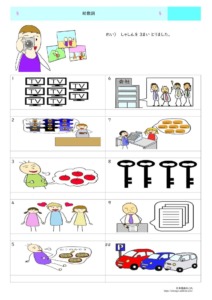
Thumbnail of counter sentences PDF
You can download the materials here


中堅さん
中堅さん
I’ve prepared practice materials here!!
Now let’s practice Q&A

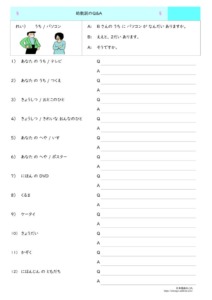
Thumbnail of counter QA PDF
You can download the materials here
 
中堅さん
中堅さん
Let’s stop here.
Please look at the second half later.

新人君
新人君
So, this is Lesson 10.
In this lesson, we will learn about the expressions “arimasu” and “imasu” used to indicate existence.

Start by carefully categorizing which words to use with “arimasu” and “imasu”.
先輩さん
先輩さん

中堅さん
中堅さん
The phrases “(place) ni ~ ga…” and “~ wa (place) ni…” have tricky particle positions.
Anyway, make sure to always include “ni” after the place…

There are many words to indicate positions,
which can be hard to remember.
It’s good to make many sentences to naturally memorize them!
ベテランさん
ベテランさん

新人君
新人君
The goal of this lesson is…

Minna no Nihongo “Lesson 10” Goals

“Being able to convey whether something exists or who is present at a location”
“Being able to convey the whereabouts of things, people, and animals”


There is/are (object/person/animal) in (place)

(Draw a picture of a park on the whiteboard, including trees, a dog, a bench, etc.)

Teacher
Teacher
There is a tree in the park.
There is a bench in the park.
There is a dog in the park.
There is a girl in the park.

Point

Explain that “arimasu” is used for objects and “imasu” is used for people and animals.


(Draw a picture of a classroom on the whiteboard, adding people and objects.)

Teacher
Teacher
In the classroom…

There is a boy in the classroom.
There is a desk in the classroom.
There is a teacher in the classroom.
学生さん
学生さん

Point

To avoid confusion, also explain the differences between “(place) e” and “(place) de” learned previously.

Confirm and practice sentence patterns with flashcards

Board Writing

(place) ni object ga arimasu.
kouen ni ki ga arimasu.
kyoushitsu ni tsukue ga arimasu.
toukyou ni onsen ga arimasu.

(place) ni person/animal ga imasu.
kouen ni inu ga imasu.
kyoushitsu ni otokonoko ga imasu.


There is/are ~ at the place (position)

(Draw a picture of a desk. On the desk, draw a pencil, under the desk draw a boy, a cat, and on the desk draw a book and a pencil.)
(Pointing to the top and bottom of the desk…)

Teacher
Teacher
On top of the desk, under the desk… these are places.

(Pointing to the pencil on the desk)

Teacher
Teacher
On top of the desk…

There is a pencil on top of the desk.
学生さん
学生さん

Confirm and practice sentence patterns with flashcards

Board Writing

(place) ni object ga arimasu.
(tsukue no ue) ni hon ga arimasu.
(tsukue no shita) ni kaban ga arimasu.

(place) ni person/animal ga imasu.
(tsukue no shita) ni neko ga imasu.
(doa no mae) ni kodomo ga imasu.

(honya to ginkou no aida) ni yuubinkyoku ga arimasu.


中堅さん
中堅さん
I’ve prepared practice materials for you!!

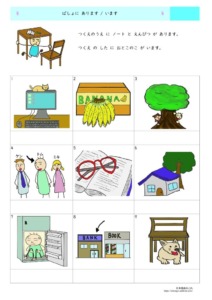
Thumbnail of Basho ni arimasu imasu PDF
Japanese Grammar Materials: “Basho ni arimasu/imasu”


中堅さん
中堅さん
This time, I’ve prepared two practice materials!!

Thumbnail of Basho ni arimasu information gap PDF
Japanese Grammar Materials: “Arimasu/Imasu” Information Gap


~ya~nado

(Pointing to a student’s desk with few things on it…)

Teacher
Teacher
On top of A-san’s desk…

There are books and pens.
学生さん
学生さん

(Pointing to a student’s desk with many things on it…)

Teacher
Teacher
On top of B-san’s desk…

There are pens, a cellphone, a book, an eraser, and…
学生さん
学生さん

Teacher
Teacher
There are pens, a cellphone, a book… It’s a lot.
There are things like pens and cellphones.

It’s a lot to list everything,
so emphasize giving two examples.
Teacher
Teacher
In the classroom…

There are things like a clock and a TV.
学生さん
学生さん
Board Writing

A to B to C to D to E ga arimasu.
→ A ya C (nado) ga arimasu.

Take a break, then it’s time for the second half.
ベテランさん
ベテランさん

新人君
新人君
We have started lesson 9 of “Minna no Nihongo”.
In this lesson, the particle “が” is introduced.

Not just that, but also the “~から” which explains reasons.
Since “~から” will be used often from now on, make sure to teach it thoroughly.
先輩さん
先輩さん

中堅さん
中堅さん
Moreover, adverbs are important.
We need to ensure we can teach how to use “とても”, “よく”, “だいたい”, “たくさん”, and “すこし” correctly.

Let’s organize everything clearly and teach it efficiently.
先輩さん
先輩さん

中堅さん
中堅さん
The first part of “~から” indicates the reason…
Students with an English-speaking background often get this order reversed.
Let’s pay attention to that…

If they can master the use of “~から”,
they will be able to construct even longer sentences than before!
ベテランさん
ベテランさん

This is the goal for this lesson!!
先輩さん
先輩さん

Goals for Lesson 9 of “Minna no Nihongo”

Being able to use the particle “が” with adverbs in conversation.
Being able to state reasons.


~が好きです

(Draw a picture of a fish on the whiteboard, next to it draw a picture of a person with a heart coming out of their head)

Teacher
Teacher
I like fish.

(Draw a picture of a person with a jagged heart coming out of their head next to the previous picture of the fish)
Teacher
Teacher
Yamada-san dislikes fish.

Point

To illustrate different intensities like “とても” (very), “あまり” (not much), “ぜんぜん” (not at all), “嫌い” (dislike), increase the number of hearts or add a skull mark.

Practice with flashcards

Blackboard

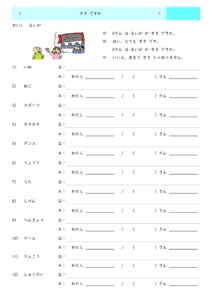
わたし は さかな  とても  すき  です
                 すき  です
            あまり  すき  じゃありません
                 すき  じゃありません
            ぜんぜん すき  じゃありません。
            とても  きらい です
                 きらい です
(Do not cover “あまり嫌いじゃありません。” or “全然嫌いじゃありません。” as these are nuanced.)


~が好きですか。

Teacher
Teacher
A-san, do you like coffee?

Yes, I like it very much.
学生さん
学生さん

Teacher
Teacher
B-san, do you like coffee too?

No, I don’t like it very much.
学生さん
学生さん

Ask other students as well to introduce the topic.

Blackboard

Q:コーヒー が すき  ですか。
A:はい、とても すき  です。
   はい、    すき  です。
 いいえ、     すき  じゃありません。
      あまり すき  じゃありません。
          きらい です。


どんな~が好きですか。

Teacher
Teacher
A-san, do you like fruit?

Yes, I like it.
学生さん
学生さん

Teacher
Teacher
What kind of fruit do you like?

I like mandarin oranges.
学生さん
学生さん

Teacher
Teacher
B-san, what kind of cars do you like?

I like small cars.
学生さん
学生さん
Point

It is also good to check answers using nouns and adjectives.


Blackboard

Q:どんな くだもの が すき ですか。
A:     みかん が すき です。

Q:どんな   くるま が すき です か。
A:ちいさい  くるま が すき です。
   べんり  くるま が すき です。
   トヨタ  くるま が すき です。


上手です

(Draw a picture of a person cooking on the whiteboard, draw a thumbs up next to it)

Teacher
Teacher
My mother is good at cooking.

(Draw a picture of a person cooking on the whiteboard, draw a thumbs down next to it)
Teacher
Teacher
My father is not good at cooking.


Give more example sentences.

Point

Explain that it’s not common to use “上手です” (good at) for oneself.
Also mention that “下手です” (bad at) can be considered rude, so avoid using it for others.


Blackboard

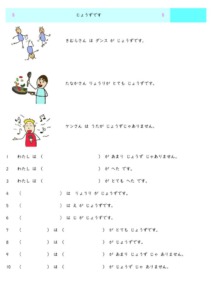
りょうり  とても  じょうず です
            じょうず です
       あまり  じょうず じゃありません
       ぜんぜん じょうず じゃありません
            へた   です


中堅さん
中堅さん
I have prepared practice materials here!!

じょうず・へたのサムネイル
You can download the materials from here


~がわかります

(Write random hiragana on the whiteboard)

Teacher
Teacher
Everyone, what is this?

“み”, “ゆ”, “き”, “し”, “そ” …
学生さん
学生さん

Teacher
Teacher
You all understand hiragana.

(Write unfamiliar kanji on the whiteboard)

Teacher
Teacher
What is this?

….
学生さん
学生さん

Teacher
Teacher
You all don’t understand kanji.

(Write katakana on the whiteboard, including some difficult ones like “フェ” and “ヴィ”)

Teacher
Teacher
What is this?

“メ”, “ア”, “…”, “モ”, “…” …
学生さん
学生さん

Teacher
Teacher
You all understand most katakana.
Point

Ask questions that prompt responses like “よく” (well), “すこし” (a little), “あまり” (not much), “ぜんぜん” (not at all).
For answers like people’s names or phone numbers that have a single correct response, do not use adverbs like “よく” or “あ まり”.
For “すこし” and “あまり”, the degree of understanding can vary based on the speaker’s feelings.


Blackboard

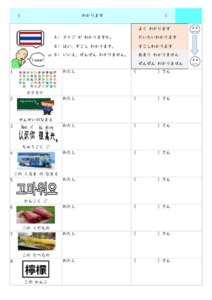
ひらがな   よく   わかります
カタカナ   だいたい わかります
かんこくご  すこし  わかります
かんこくご  あまり  わかりません
ロシアご   ぜんぜん わかりません


中堅さん
中堅さん
I have prepared practice materials here!!

わかりますかのサムネイル
You can download the materials from here
新人君
新人君
Shall we take a break here?
The second half covers “あります” (existence) and “~から” (reason).

新人君
新人君
This is Lesson 8 of “Minna no Nihongo”.
Here, we will be studying adjectives.
If we can talk about our feelings, it will be exciting.

中堅さん
中堅さん
Are you sure you can afford to be so relaxed?
Negative forms, “Donna + noun,” “Adjective + noun”
There are many stumbling points…

Students’ ability to express themselves will dramatically increase, so conversations will be more lively from this lesson.
先輩さん
先輩さん

There are many words used in daily life, so vocabulary retention is easier!
ベテランさん
ベテランさん

If you teach them carefully, there won’t be any problems!
Make sure to prepare well.
先輩さん
先輩さん

This is the goal of this lesson!!
ベテランさん
ベテランさん

The Goal of “Minna no Nihongo” Lesson 8

“Using adjectives, express feelings and impressions, and talk about the state of things.”


~ wa (adjective) desu.

(Draw a picture of a person who looks bored on the whiteboard)

Teacher
Teacher
Tanaka-san is bored.

(Draw a picture of a person who looks busy on the whiteboard)
Teacher
Teacher
Yamada-san is busy.

Practice sentences with adjectives using flashcards.
Create sentences by providing vocabulary for adjectives.

Board Notes

たなか さん は ひまです。
やまださん は いそがしいです。
えいご は やさしいです。
にほんご は むずかしいです。


Na-Adjectives and I-Adjectives (Negative Forms)

(Using the previous drawings…)

Teacher
Teacher
Is Tanaka-san bored?

Yes, he is bored.
学生さん
学生さん

Teacher
Teacher
Is Yamada-san bored?

No, he is not bored.
学生さん
学生さん

Teacher
Teacher
Is Yamada-san busy?

Yes, he is busy.
学生さん
学生さん

Teacher
Teacher
Is Tanaka-san busy?

No, he is not busy.
学生さん
学生さん

Teacher
Teacher
“No, he is not busy” is incorrect.
It should be “No, he is not busy (negative form).”
Points

Here, open the vocabulary page of the textbook again and explain the “na-adjectives” and “i-adjectives”.
Explain that “kirei” and “yuumei” look like “i-adjectives” but are actually “na-adjectives”.
Practice separating “na-adjectives” and “i-adjectives” (orally or with a handout…).
Practice changing “na-adjectives” and “i-adjectives” to negative forms (orally or with a handout…).


Board Notes

(な形容詞)
Q:たなかさんはひまですか。
A:はい、ひまです。

Q:やまださんはひまですか。
A:いいえ、ひまじゃありません。

(い形容詞)
Q:やまださんはいそがしいですか。
A:はい、いそがしいです。

Q:たなかさんはいそがしいですか。
A:◯ いいえ、いそがしくないです。
✖ いいえ、いそがしいじゃありません。

い形容詞
いそがしです。
     ↓
いそがしくないです。


Q&A with Na-Adjectives and I-Adjectives

After being able to distinguish adjectives, practice with pair work.

Points

Explain in advance that the negative form of “ii” is “yokunai,” not “ikunai.”


How is it?

Teacher
Teacher
A-san, is the bus in Japan clean?

Yes, it is clean.
学生さん
学生さん

Teacher
Teacher
B-san, is the bus in Japan convenient?

Yes, it is convenient.
学生さん
学生さん

Teacher
Teacher
C-san, is the bus in Japan cheap?

No, it is not cheap.
学生さん
学生さん

Teacher
Teacher
How is the bus in Japan?

It is clean.
It is convenient.
It is not cheap.
Teacher
Teacher

Practice Q&A with flashcards

Board Notes

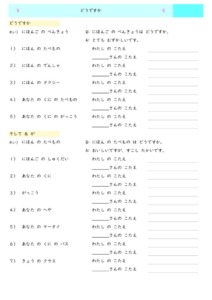
Q:にほんのバスはどうですか。
A:べんりです。
   きれいです。
   やすくないです。
   はやいです。


~ desu. Soshite ~ / desu. ~ desu ga, ~ desu.

(Using the previous board notes…)

Teacher
Teacher
How is the bus in Japan?

Teacher
Teacher
It is convenient. And it is clean.

Teacher
Teacher
It is convenient, but it is not cheap.

Points

Draw a 😊 mark under “convenient” and “clean.” Draw a 😢 mark under “not cheap.”
Explain the use of “and” and “but” by combining positive and negative feelings.

Ask students questions and have them answer by connecting two adjectives.
 
Board Notes

Q:にほんのバスはどうですか。
😊 べんりです。
😊 きれいです。
😢 やすくないです。
😢 おそいです。
(かおのえもじをかく)

A:べんりです。そして、きれいです。
   😊         😊
べんりですが、やすくないです。
   😊         😢
やすくないです。そして、おそいです。
   😢         😢


中堅さん
中堅さん
I’ve prepared practice materials here!!

Thumbnail of How is it? And/But
You can download the materials from here
Are you following so far? The second half is also important.
先輩さん
先輩さん

新人君
新人君
It’s Lesson 7.
The expressions we’re dealing with in this lesson are…
They look tough.

Yeah, but the first part “with tools” is the same as the “with vehicles” in Lesson 4, so it’s easy, right?
先輩さん
先輩さん

中堅さん
中堅さん
The expression “(Person) gives (Person) ~” can be introduced without any problem, but when the textbook introduces “(Person) gives ~” with the implied “(I)” omitted… everyone gets confused.

Make sure to emphasize that “I” is implied.
先輩さん
先輩さん

The goal of this lesson is… here it is!!
ベテランさん
ベテランさん

Goals for Lesson 7 of “Minna no Nihongo”

“To be able to express how to do something.”
“To be able to use giving and receiving expressions.”


With (Tool)

(Draw a picture of a person eating sushi with chopsticks on the whiteboard)

Eat sushi.
学生さん
学生さん

(Circle the chopsticks part on the whiteboard.)
教師
教師
Eat sushi with chopsticks.

(Draw a picture of a letter on the whiteboard)

教師
教師
With a ballpoint pen…

Write a letter with a ballpoint pen.
学生さん
学生さん

Review and practice sentence patterns with flashcards

Board Writing

はし     すし  を たべます。
ボールペン  てがみ を かきます。
はさみ    かみ  を きります。


Why (Verb)?

(Draw a picture of a fish on the whiteboard and put a question mark on the tool part)

教師
教師
Why do you cut the fish?

Cut it with a knife.
学生さん
学生さん

(Draw a picture of a report on the whiteboard)

教師
教師
Why do you send the report?

Send it by email.
学生さん
学生さん

Practice making Q&A with flashcards
Practice in pairs

Board Writing

Q:なんで さかなを きりますか。
A:はさみで きります。
Q:なんで れぽーとを おくりますか。
A:メールで おくります。

 
Download the materials from here.
先輩さん
先輩さん
 

With (Language)

(Write “Thank You” on the whiteboard)

教師
教師
This is “Thank You”.
(Write “Japanese: ありがとう” under “Thank You”)
教師
教師
“Thank You” in Japanese is “ありがとう”.
(Write “Malay: Terima Kasih” under ありがとう)
教師
教師
“Thank You” in Malay is “Terima Kasih”.

Practice with flashcards, real words, and classroom items

Board Writing

“Thank you” is in Japanese “ありがとう”.
It is in Malay “Terima Kasih”.
It is in Chinese “謝謝”.

What is it in (Language)?

(Write “Chinese: ?” under “Thank You” earlier)

教師
教師
What is “Thank You” in Chinese?

It is “謝謝”.
学生さん
学生さん

(Point to the clock…)

教師
教師
What is that in Japanese?

It is “時計”.
学生さん
学生さん

Practice combining various things and languages

 
Board Writing

「ありがとう」 は えいご で  なん   です か。
               「Thank you」です。
これ は にほんご で なん です か。
           とけい です。


中堅さん
中堅さん
I’ve prepared practice materials here!!

Lesson 7 7-3 (language) A thumbnail Lesson 7 7-3 (language) B thumbnail
新人君
新人君
You can download the materials from here.

 Various materials for Japanese grammar “with languages”

Okay, that’s the end of the first half.
The second half is about “giving and receiving expressions”.
It’s going to be tough!!
ベテランさん
ベテランさん

Kanji Stroke Order Dictionary: Effective Usage and Application in Japanese Schools


新人君
新人君
Learning kanji is tough, isn’t it?
Especially remembering the stroke order is quite challenging.
But with the “Kanji Stroke Order Dictionary,” that problem can be solved.

 Kanji Stroke Order Dictionary

Oh, I use it too!
You can see the stroke order animated.
It’s very easy to understand, and beginner students really appreciate it.
先輩さん
先輩さん

中堅さん
中堅さん
You don’t need to rely on that. Just make them write a lot, and they’ll remember.
Kanji is all about spirit.

No, no, this site is really useful.
Especially for use in classes or self-study.
It’s perfect for visually understanding the stroke order.
ベテランさん
ベテランさん

新人君
新人君
Yes, learning visually makes it easier to remember.
I searched for the kanji “曖” and the stroke order was clear at a glance.

Why “曖”?
Well, never mind that.
By practicing repeatedly, you naturally learn the correct stroke order.
It’s great to be able to check if you’re writing in the correct order while writing multiple times.
先輩さん
先輩さん

中堅さん
中堅さん
Well, that’s true.
You could pick out the kanji you’re not good at, and
check them on the site to remember them effectively.

That’s right.
Especially in Japanese schools, it can be used as supplementary material in classes. It can also be used as a self-study tool during free time.
Using it in class makes it easier for the whole class to understand visually.
ベテランさん
ベテランさん

新人君
新人君
It can also be used for review at home.
When reviewing kanji learned in class at home, you can use the site to thoroughly check the stroke order.

You can use it for checking before tests, too.
If you use the site to check whether you can write kanji in the correct stroke order,
you can feel more confident.
先輩さん
先輩さん

中堅さん
中堅さん
You could use it like a quiz.
First show the kanji, have them guess the stroke order,
and then show the animation.

That sounds good.
You can even copy and paste the animation into PowerPoint.
And the animation will still work in PowerPoint!!
ベテランさん
ベテランさん

新人君
新人君
Specifically, how do you do that?

For example, when learning the kanji “学,”
first search for it on the site and right-click on the animation.
Then, just paste it into PowerPoint.
ベテランさん
ベテランさん

If you can embed it in PowerPoint, you can use it without interrupting the flow of the lesson.
先輩さん
先輩さん

中堅さん
中堅さん
It would be nice to have everyone air-write along with the animation.

新人君
新人君
Yes, using this site
could make learning kanji more enjoyable and effective.

That’s right.
This “Kanji Stroke Order Dictionary” site is a powerful tool to support kanji learning.
Everyone, please try using it to make your kanji learning more effective.
You can access the dictionary from the link below.
ベテランさん
ベテランさん

先輩さん
先輩さん

中堅さん
中堅さん
Maybe I should use it to study for the Kanji Kentei.

新人君
新人君
Are you taking the Kanji Kentei?
That’s amazing.

Everyone, please make use of this site!
ベテランさん
ベテランさん

「謙譲語」の教材

新人君
新人君
今回は「謙譲語」の教材を作ってみました。(This time, I created some materials for “humble language.”)

へぇ、なぜ「謙譲語」の教材を突然作ったの?(Oh, why did you suddenly decide to make materials on “humble language”?)
先輩さん
先輩さん

中堅さん
中堅さん
まあ、適当に選んだんじゃない?(Well, maybe they just picked it at random?)

今回は全部で5枚か?
教科書の内容はそんなに多くないが…(So, there are five sheets in total this time? The content in the textbook isn’t that extensive, though…)
ベテランさん
ベテランさん

新人君
新人君
ええと…
今回はとにかく会話文を尊敬語と謙譲に変える練習を増やしました。(Well… This time, I focused on adding more practice for converting dialogue into honorific and humble language.)

そうね、この二つは慣れるしかないわね…(True, you just have to get used to these two…)
先輩さん
先輩さん

お~します(1枚目)

新人君
新人君
今回も1ページ目は、形を変える練習を作ってみました。
まずは相手に関係する動作をするときの「お~します」「ご~します」です。(For the first page this time, I created practice for changing forms. Let’s start with “o~shimasu” and “go~shimasu” when performing actions related to someone else.)

勘違いして「お食べします」とか「お飲みします」のようなことを言う学生もいるわね。
最初にきちんと説明していれば、ミスが防げるわね。(Some students mistakenly say things like “o-tabeshimasu” or “o-nomishimasu.” If you explain it properly at first, you can prevent such mistakes.)
先輩さん
先輩さん

中堅さん
中堅さん
形の変え方は簡単だから、
宿題かなんかで使えばいいんじゃない?
使う場面をきちんと導入して…(The way to change the form is simple, so it might be good to use it in homework or something. Just make sure to introduce the situations properly…)

新人君
新人君
そうですね。(That’s right.)

後半の練習は後件を考える問題ね。(The second half of the practice is about thinking through the consequences.)
先輩さん
先輩さん

謙譲語1のサムネイル ダウンロード!(Download!)

特別な形の謙譲語(2枚目)

次のページは特別な形の謙譲語ね?(The next page is about special forms of humble language, right?)
先輩さん
先輩さん

新人君
新人君
ええ、こちらは暗記するしかないんですが…(Yes, but unfortunately, you just have to memorize these…)

一緒に確認しながら、
答えを書かせるしかないんじゃないか? (You might have to go over them together and have them write the answers.)
ベテランさん
ベテランさん

中堅さん
中堅さん
そうね…
考えたら答えがわかるというものでもないわね…(True… It’s not something you can figure out just by thinking about it…)

謙譲語2のサムネイル ダウンロード!(Download!)

尊敬語と謙譲語の会話(3枚目)

3枚目だな…
この課で導入することは終わったが、
尊敬語との使い分けが重要だな!(This is the third page… We’ve finished introducing things in this lesson, but distinguishing between honorific and humble language is crucial!)
ベテランさん
ベテランさん

新人君
新人君
ええ、だれの行動なのかを考える必要がありますね。(Yes, you need to think about whose action it is.)

慣れるしかないのね…(You just have to get used to it…)
先輩さん
先輩さん

謙譲語3のサムネイル ダウンロード!(Download!)

尊敬語と謙譲語の会話(4枚目)

中堅さん
中堅さん
じゃあ、4枚目は読解かしら?(So, is the fourth page reading comprehension?)

新人君
新人君
ええと…
読解は無理でした。
なので更に会話の変形の練習を入れてみました。(Well… Reading comprehension was a bit too much. So, I added more practice for transforming conversations.)

今度のはさっきより長いわね…(This one is longer than the last…)
先輩さん
先輩さん

謙譲語4のサムネイル ダウンロード!(Download!)

まあ、4枚あれば十分だろう!!(Well, four pages should be enough!!)
ベテランさん
ベテランさん

尊敬語と謙譲語の会話(5枚目)

最後だな!
今度は何の練習を入れたんだ?(This is the last one! What kind of practice did you include this time?)
ベテランさん
ベテランさん

中堅さん
中堅さん
あなたの好きなペアワーク?(Pair work, your favorite?)

ああ、いつものパターンね!(Ah, the usual pattern!)
先輩さん
先輩さん

新人君
新人君
ええと…
すみません。4枚目の続きです…
さっきの会話がうまく終わらせられなくて…(Uh… Sorry. It’s a continuation from the fourth page… I couldn’t quite finish the conversation earlier…)

そして、他の活動を作る体力はもうないと…
もうちょっと工夫しなさい!!(And you don’t have the energy to create more activities… Put in a little more effort!)
先輩さん
先輩さん

新人君
新人君
すみません。
眠くなってしまったんです…(I’m sorry. I just got so sleepy…)

謙譲語5のサムネイル ダウンロード!(Download!)

中堅さん
中堅さん
「謙譲語」の教案はこちらのページで見てください…(Please check the lesson plan for “humble language” on this page…)

みんなの日本語の教え方(第50課の教案と教材) 敬語(謙譲語)の導入と練習
(How to Teach Minna no Nihongo (Lesson 50 Lesson Plan and Materials)
Introduction and Practice of Keigo (Humble Language))


新人君
新人君
Sigh, I’m in trouble…
What should I do…
What’s wrong?
Another problem today?
先輩さん
先輩さん

新人君
新人君
It’s a class that finished the beginner level, but there’s a student who struggles with particles, passive forms, honorifics, and giving/receiving expressions.
What should I do?

Hmm, it’s a matter of talent.
Students with good intuition can handle it!!
ベテランさん
ベテランさん

中堅さん
中堅さん
You can’t develop talent that quickly…
Maybe checking each item one by one would reduce some mistakes…

For grammar that’s easy to mistake, you have to explain it every time it comes up.
Also, when learning new vocabulary, it’s good to create sentences with blanks ( ) and have the students think about them.
先輩さん
先輩さん

新人君
新人君
That sounds like a tedious task.
Isn’t there a way to review beginner grammar all at once?

Why not use textbooks designed for reviewing after beginner level learning?
ベテランさん
ベテランさん

中堅さん
中堅さん
There are two books I always use…

Oh, what books do you use?
先輩さん
先輩さん

中堅さん
中堅さん
The first one is “Short-term Intensive Beginner Japanese Grammar Summary: 20 Points”…
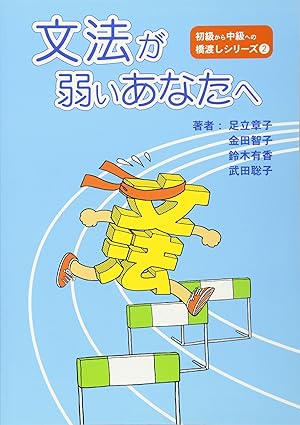
The second one is “For Those Weak in Grammar (Bridge to Intermediate Series 2)…

Ah, both are books that can be used for reviewing grammar after the beginner level!
ベテランさん
ベテランさん

新人君
新人君
Oh, so there are such books.
I’ll go buy both right away.


Features of “For Those Weak in Grammar”

中堅さん
中堅さん
These are the features and contents of the two books…

First, “For Those Weak in Grammar.”
It’s a bit old but still very useful.
This series also includes “Listening Comprehension,” “Reading Comprehension,” and “Kanji & Vocabulary.”
先輩さん
先輩さん

文法が弱いあなたへ (初級から中級への橋渡しシリーズ 2)

For Those Weak in Grammar

漢字・語彙が弱いあなたへ(初級から中級への橋渡しシリーズ 1 )

For Those Weak in Kanji & Vocabulary

聴解が弱いあなたへ (初級から中級への橋渡しシリーズ 3 )

For Those Weak in Listening Comprehension

読解をはじめるあなたへ (初級から中級への橋渡しシリーズ 4 )

For Those Starting Reading Comprehension

中堅さん
中堅さん
Yes, all of them are quite useful…
For grammar, you can do the practice problems on the left page in class, and for homework, have them do the reading comprehension plus grammar problems on the right page…

Each item is compactly summarized in two pages, so it’s easy to use as supplementary material in class.
ベテランさん
ベテランさん

新人君
新人君
The grammar covered includes the following.


  • Particles
  • Counters
  • ~て
  • ~たい/~たがる
  • ~たほうがいい
  • Various uses of “~た”
  • ~くて/~ので
  • Transitive/Intransitive verbs
  • ~ている
  • ~てある
  • ~ておく
  • ~てしまう
  • ~ことがある(experience/sometimes
  • ~ことにする/なる
  • Give/Receive expressions
  • ~か/~かどうか
  • ~しか/~だけ
  • ~くなる/~になる
  • ~増えていく/くる
  • ~はず
  • ~なければならない
  • ~つもり/~予定
  • ~ために/~ように
  • ~よう/~みたい
  • ~そうだ
  • ~と言う
  • ~と思う
  • ~と
  • ~なら
  • ~たら
  • ~ば
  • ~とき
  • Modifier clauses
  • Potential form
  • Passive form
  • Causative form
  • Causative-passive form
  • Honorifics

If they studied beginner level with “Minna no Nihongo,” there are some topics they haven’t learned yet.
先輩さん
先輩さん

中堅さん
中堅さん
Well, this book isn’t meant to be studied in order from the beginning.
You can use it for specific points as needed,
so you can use it when that grammar is learned.

Or you could use this book to introduce it, right?
ベテランさん
ベテランさん

新人君
新人君
It’s well-designed to understand how to use each grammar point. There are also quite a few illustrations, making it approachable.
And it’s nice that there’s reading comprehension for each grammar point. You can see how it’s used in sentences…
Oh, but there aren’t detailed explanations of the grammar!

That’s right.
It’s made for reviewing already learned grammar,
so it focuses on review content.
If the learner has completely forgotten that grammar…
ベテランさん
ベテランさん

中堅さん
中堅さん
The teacher will need to explain the grammar again…


Features of “Short-term Intensive Beginner Japanese Grammar Summary: 20 Points”

Now about “Short-term Intensive Beginner Japanese Grammar Summary: 20 Points.”
There’s also a series for intermediate grammar called “Key Points Summary: 20 Points.”
先輩さん
先輩さん

初級日本語文法総まとめポイント20: 短期集中

Beginner Japanese Grammar Summary: 20 Points

中級日本語文法要点整理ポイント20

Intermediate Japanese Grammar Summary: 20 Points

中堅さん
中堅さん
Yes, this series is also frequently used.

There are quite a few pages for each item.
There’s also a lot of practice.
ベテランさん
ベテランさん

新人君
新人君
The grammar covered includes the following.

  • Particles
  • “wa” and “ga”
  • Conjugation 1
  • Conjugation 2: Three Verb Groups and “te-form,” “ta-form”
  • Verb Conjugation and Sentence Patterns
  • Plain form
  • Ko-so-a
  • Offers and Invitations
  • Self or Others?
  • Continuity or Instantaneousness?
  • Speaker’s Position: “te iku/te kuru”
  • Pairs of Transitive and Intransitive Verbs
  • Potential Expressions
  • Fact or Emotion?
  • Conditions, etc.
  • Giving and Receiving: Who to Whom?
  • Causative
  • Passive/Causative-passive
  • Honorifics
  • Sentence Styles
  • Important Adverbs ①
  • Important Adverbs ②

新人君
新人君
Compared to “For Those Weak in Grammar,”
this looks more difficult.

Yes, the content of the book is more text-heavy and rigid…
But it’s designed so you can systematically review each item.
For example, even just the “Particles” section has:

  • Start Test
  • Particles Indicating Place ①
  • Particles Indicating Place ②
  • Other Particles ①
  • Other Particles ②
  • Particles Indicating Time Relationships
  • Review Questions

There are several points like this.

先輩さん
先輩さん

Furthermore, there are review questions for each point!
① Check the current understanding of the overall content with the start test
② Review and practice each detailed point
③ Check understanding on the last page
That’s the structure.
ベテランさん
ベテランさん

新人君
新人君
With this, you can definitely memorize it…
But with such detailed content, it seems hard to explain…

No need to worry.
Because,
it’s a book for reviewing already learned grammar,
and the grammar explanations are translated into English, Chinese, and Korean.
先輩さん
先輩さん

中堅さん
中堅さん
That’s right.
And while it seems complex at first glance with few illustrations,
it’s actually designed in a way that’s manageable for both the teacher and the learner.
Except for a few parts…

A few parts…?
先輩さん
先輩さん

新人君
新人君
Ah!
The pages dealing with various forms look tough.
There’s a list of grammar learned so far…
And some grammar that hasn’t been learned yet…

Hmm, if the learners remember well, it’s not a problem…
But if they’ve forgotten most of it, it’ll be tough…
ベテランさん
ベテランさん

Summary

新人君
新人君
Both books are made for reviewing beginner grammar,
so they are useful for students who have thoroughly studied the beginner level.
But it’s impossible to use them as textbooks for learning new grammar.

That’s right.
And, whichever book you use,
there are some grammar points they haven’t learned yet,
so it’s up to the teacher whether to introduce them on the spot or skip them.
先輩さん
先輩さん

中堅さん
中堅さん
It might be good to use them for specific points the learners struggle with…

Well, both are clearly made,
so keeping them handy will be useful in various situations!!
ベテランさん
ベテランさん

新人君
新人君
あれっ、あそこのアパート…
いくつかの部屋で入居者を募集していますね。
なかなか空き部屋が出ないのに珍しいですね…

聞いた話では近くにもっときれいで安いアパートできたから、
そちらへ引っ越しした人が少なくないとか…
先輩さん
先輩さん

中堅さん
中堅さん
私が聞いた話では…
あのアパートで何か事件が起きたとか…
それで引っ越した人があとを絶たないとか言っていたわよ。

それはチャンスだな。
事件が起きた後は家賃が下がるとか…
ベテランさん
ベテランさん

This time let’s look at the expression “toka”.
This expression is used like “I hear a new ~ is going to be released.”
It is a hearsay expression used when telling someone else something that you have heard,
and the speaker feels that the information is not reliable.
It can also be used in other ways, such as “I hear you’re getting married soon. Congratulations,”
where you tell the person what you have heard about them and then give your opinion in the postscript.

(隣の奥さんと話している主婦の絵を貼る)

教師
教師
隣の奥さんと話しています。
この間、噂で息子さんが大学に合格したと聞きました。
どうやって、おめでとうと言いますか。

息子さんが大学に合格したそうですね。おめでとうございます。
息子さん、大学に合格したと聞きました。おめでとうございます。
学生さん
学生さん

教師
教師
はい、そうですね。
いろいろな言い方がありますね。
今日も新しい言い方を勉強します。
息子さんが大学に合格なさったとか。おめでとうございます。
です。
「とか」も「伝聞表現」です。
確信がない時や、情報をどこから得たかはっきり言いたくないときに使います。

(男の人が料理をしている絵を貼る)
教師
教師
また別の奥さんと話しています。
この奥さんのご主人は料理が趣味だとうわさで聞きました。
いつも家族のために料理を作っているそうです。
それに比べて、私の主人は、いつも食べて寝るだけです。
本当にうらやましいです。
奥さんにどう言いますか?

ご主人は料理が趣味だとか。本当にうらやましいです。
学生さん
学生さん

(家族で引っ越しをしている絵を貼る)
教師
教師
また、別の奥さんと話しています。
ご主人が大阪に転勤になるという噂を聞きました。
引っ越しの準備が大変そうです。
奥さんにどう伝えますか?

今度、ご主人が大阪に転勤なさるとか。いろいろと大変ですね。
学生さん
学生さん

(喫煙所でおしゃべりをしている会社員の絵を貼る)
教師
教師
この会社には喫煙所があります。
同僚とたばこを吸いながらおしゃべりするのは楽しいです。
でも、最近こんな噂があります。
噂なので確信はありませんが、
来年からこのビルは全面禁煙になるという噂です。
他の人にどう伝えますか。

来年からこのビルは全面禁煙になるとか。
学生さん
学生さん

(ある男の人について噂をしている、人の絵を貼る)
教師
教師
私の同僚の山田さんは去年お母さんが病気になりました。
それで、社内では山田さんがこの会社を辞めて、
田舎の両親の元に帰るという噂が流れています。
他の社員にこのことについて話したいです。
どう言いますか。

山田さんはこの会社を辞めて、田舎の両親の元へ帰るとか。
学生さん
学生さん

(太っている上司の絵を貼る)
教師
教師
私の上司です。
最近、上司は元気がありません。
私はその理由を誰かから聞いたことがあります。
この間の健康診断で医者に生活習慣を変えろと言われたという話です。
私は他の社員にどうして元気がないのか聞かれました。
どう言いますか?

部長、この間の健康診断で医者に生活習慣を変えろと言われたとか。
学生さん
学生さん

(若者たちの絵を貼る)
教師
教師
私はこの間インターネットでこんな記事を見ました。
・最近の車を買わない若者が増えている
・最近の若者は身内だけの小さな結婚式をする人が多い
・最近の若い人はテレビを見ない
という記事です。
みなさん、この原因について何か聞いたことがありますか?

最近は経済の低迷で、車を所有したいと考える若い人が減ったとか。
大きい結婚式は費用が高いので、家族だけで簡単に済ませる人が多いとか。
最近の若い人はパソコンで動画見ることの方が多いので、テレビを見ないとか。
学生さん
学生さん


Chalkboard writing

息子さんが大学に合格なさったとか。おめでとうございます。
ご主人は料理が趣味だとか。本当にうらやましいです。
今度、ご主人が大阪に転勤なさるとか。いろいろと大変ですね。

来年からこのビルは全面禁煙になるとか。
山田さんはこの会社を辞めて、田舎の両親の元へ帰るとか。
部長、この間の健康診断で医者に生活習慣を変えろと言われたとか。

最近は車を所有したいと考える若い人が減ったとか。
大きい結婚式を開かないで家族だけで簡単に済ませる人が多いとか。
最近の若い人はテレビより、パソコンで動画見ることの方が多いとか。


practice

① (              )とか。もし本当だとしたら残念だね。

② 彼の家には(           )とか。うらやましいですね。

③ (                  )とか。かわいいでしょうね。

④ 彼は(                )とか。すごいなあ。

⑤ 彼女は飲み会には(           )とか言っていましたよ。

⑥ (             )とか。どんどん生活が便利になりますね。

⑦ (             )とか。時代は変わりましたね。

⑧ (             )とか。一緒に食べに行きませんか。

⑨ あの店の食べ物は安くて量が多いから、(          )とか。

⑩ 今年の夏は例年と比べると(                )とか。