Sponsored Links

新人君
新人君
It’s lesson 6.
This lesson is about studying verbs used in daily life.

As students learn this lesson,
they will be able to express more things,
making it more fun to speak in Japanese.
先輩さん
先輩さん

中堅さん
中堅さん
By asking various questions as a review,
you can also build closer relationships with students…

From now on, before starting the class,
I can ask students various questions
to create an ice-breaking time!!
ベテランさん
ベテランさん

中堅さん
中堅さん
The goal of this lesson is this…

Goals for Lesson 6 in “Minna no Nihongo”

“To be able to talk about daily life using verbs”
“To be able to invite people”


~を(verb)./(person)にあいます。

(Draw pictures of people doing various things on the whiteboard)

(Pointing to the part of the picture where it says “tonight” and shows eating fish…)
Teacher
Teacher
これはなんですか。
(What is this?)

さかな です。(It’s a fish.)
学生さん
学生さん

(Pointing to the picture of the person eating…)

たべます。(I eat it.)
学生さん
学生さん

Teacher
Teacher
こんばん わたし は さかな を たべます。(Tonight, I will eat fish.)

Use flashcards of drinks, books, cigarettes, etc. to check the sentence patterns.

(Pointing to the part of the picture where it says “last week” and shows meeting a friend…)

Teacher
Teacher
これは なんです か。(What is this?)

ともだち です。(It’s a friend.)
学生さん
学生さん


(Pointing to the picture of the action of meeting…)

せんしゅう ともだち を あいました。(I met a friend last week.)
学生さん
学生さん

Teacher
Teacher
せんしゅう ともだち に あいました。(I met with a friend last week.)

Point!!

In this lesson, continue to introduce verbs with “affirmative/negative” and “present/past” in mind.
I think this will help students to use them more smoothly.


On the board

あした   さかな   たべます。
きのう   ビール   のみました。
まいばん  テレビ   みます。
せんしゅう  ともだち  あいました。


中堅さん
中堅さん
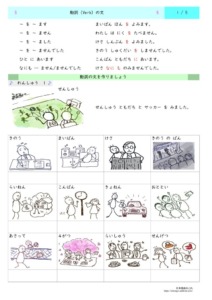
I have prepared practice materials here!!


Thumbnail of Verbs Sentence 1 PDF
You can download the materials from here.


(Tense) ~ますか。/ ~ましたか。
    Yes, ~ます。/ ~ません。
    No, ~ません。/ ~ませんでした。

(Adding a question mark to the notes on the board)

Teacher
Teacher
~さん、あした さかな を たべますか。(Will you eat fish tomorrow?)

はい、たべます。(Yes, I will eat it.)
学生さん
学生さん

Teacher
Teacher
~さん、きのう ビールを飲みましたか。(Did you drink beer yesterday?)

いいえ、飲みませんでした。(No, I didn’t.)
学生さん
学生さん
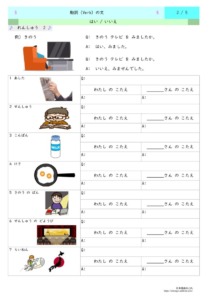
On the board

Q: あした さかな たべますか?
A:       はい、たべます。
        いいえ、たべません。
Q: きのう ビール のみましたか?
A:       はい、のみました。
        いいえ、のみませんでした。
Q: せんしゅう ともだち にあいましたか?
         はい、あいました。
        いいえ、あいませんでした。
 

中堅さん
中堅さん
I have prepared practice materials here!!


Thumbnail of Verbs Sentence 2 PDF
You can download the materials from here.


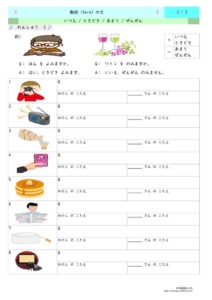
Q: ~ますか。
A:Yes, (always/ sometimes) ~ます。
   No, (not much/ never) ~ません。

(Draw a weekly schedule on the whiteboard)

Teacher
Teacher
ケンさんは
げつようび ビール を のみます。
かようび も ビール を のみます。
すいようび も ビール を のみます。
もくようび も、きんようび も、どようび も、にちようびも…。 (Ken drinks beer on Monday. He drinks beer on Tuesday. He drinks beer on Wednesday. Thursday too, Friday too, Saturday too, and Sunday too…)

(Adding circles under each day)
Teacher
Teacher
ケンさんは いつも  ビール を のみます。(Ken always drinks beer.)

Teacher
Teacher
ミカさんは
げつようび と すいようび と きんようび テレビ を みます。
ミカさん は ときどき テレビ を みます。 (Mika watches TV on Monday, Wednesday, and Friday. Mika sometimes watches TV.)


Introduce “not much” and “never” in the same way.

On the board

ケンさん いつも ビールをのみます。
ミカさん ときどき テレビをみます。
エドさん あまり ビールをのみません。
わたし ぜんぜん テレビをみません。
(Ken always drinks beer. Mika sometimes watches TV. Ed doesn’t drink much beer. I never watch TV.)


Teacher
Teacher
Aさん は ビール を のみますか。(A-san, do you drink beer?)

はい、ときどき のみます。(Yes, sometimes I do.)
学生さん
学生さん

Teacher
Teacher
Bさん は えいが を みますか。(B-san, do you watch movies?)

いいえ、あまり みません。(No, I don’t watch them much.)
学生さん
学生さん

Once students have learned about frequency, practice QA by asking questions.

Point!!

Remember that “very” and “sometimes” are used in affirmative sentences,
while “not much” and “never” are used in negative sentences.
Sometimes students make mistakes like saying “I eat not much.”
 

中堅さん
中堅さん
I have prepared practice materials here!!


Thumbnail of Verbs Sentence 3 PDF
You can download the materials from here.


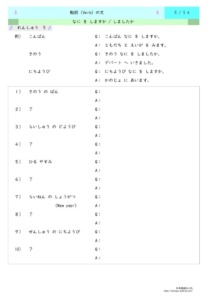
What do you (verb)?

(Draw a picture of a person eating something on the whiteboard. What is it? Mark)

Teacher
Teacher
~さんは こんばん なに を たべますか。(What will you eat tonight?)

さかな を たべます。(I will eat fish.)
学生さん
学生さん

Teacher
Teacher
~さん は けさ なに を のみましたか。(What did you drink this morning?)

コーヒー を のみました。(I drank coffee.)
学生さん
学生さん

Teacher
Teacher
~さん は きのう だれ に あいましたか。(Who did you meet yesterday?)

ともだち に あいました。(I met a friend.)
学生さん
学生さん

Encourage students not only to answer but also to create questions.

Point!!

In the practice so far, if answers like “nothing” or “no one” come out of the students’ mouths,
you can introduce them at that time.
If it doesn’t come up, draw a picture or explain orally.
“There is no one to meet.” might come up as an answer.
Explain that “no one” connects naturally with “to meet” and that “に” cannot be omitted.


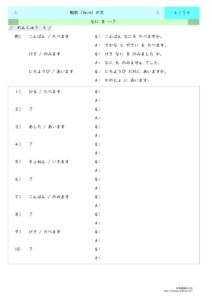
On the board

Q: こんばん なにを たべますか?
A:    さかなをたべます。
       なにもたべません。

Q: けさ なにを のみましたか?
A:   コーヒーをのみました。
       なにものみませんでした。

Q: きのう だれに あいましたか?
     ともだちにあいました。
       だれにもあいませんでした。


What did you do?

(Write “Sunday” on the whiteboard and draw various activities below it)

Teacher
Teacher
~さん は にちようび なに を しましたか。(What did you do on Sunday?)

(Pointing to the picture of reading a book)
ほん を よみました。(I read a book.)
学生さん
学生さん

(Pointing to the picture of going to the supermarket)
スーパー へ いきました。(I went to the supermarket.)
学生さん
学生さん

(Pointing to the picture of meeting a girlfriend)
かのじょ に あいました。(I met my girlfriend.)
学生さん
学生さん


Point!!

The answer to “What do you do? / What did you do?” doesn’t always have to use “~をします。/~をしました。”.
Make sure that students can freely use other verbs.
It’s also good to introduce and practice “nothing” here.


On the board

Q: にちようび なにをしましたか?
A:      ほんをよみました。
     スーパーへいきました。
     かのじょにあいました。
      なにもしませんでした。
Make students aware of the freedom in answers!!
ベテランさん
ベテランさん
中堅さん
中堅さん
I have prepared practice materials here!!


Thumbnail of Verbs Sentence 4 PDF Thumbnail of Verbs Sentence 5 PDF
You can download the materials from here.
 
中堅さん
中堅さん
Is this the end of the first part…?
In the second part, we will learn “verb + at place”, “won’t you”, and “let’s”.
 

新人君
新人君
It’s Lesson 5.
This lesson also has a lot of vocabulary.
Dates like the first, second, third…
This is going to be tough.

That’s right.
Also, some verbs will appear in this lesson.
先輩さん
先輩さん

中堅さん
中堅さん
Verbs related to movement.
It’s good to practice while being aware of tenses…

The tricky points in this lesson are…
“Not going anywhere,” “alone,” “walking,” etc.
Well, it’s relatively easy to remember, but…
ベテランさん
ベテランさん

If you check the dates and days of the week before starting each class,
students will gradually remember them.
先輩さん
先輩さん

中堅さん
中堅さん
Just like in Lesson 4, include verb tense practice and get students used to sentence endings.

This is the goal for this lesson!!
ベテランさん
ベテランさん

Goals for “Minna no Nihongo” Lesson 5

Be able to have conversations using sentence patterns related to moving to a location


Go to (location).

(Draw a picture of a person heading to a location on the whiteboard,
and write the timing to get students used to tenses)

Teacher
Teacher
The day after tomorrow, I will go to the hospital.
Every day, I come to school.
Yesterday at 7, I went home.

Important points for this lesson!!

When the teacher points to a drawing,

encourage students to spontaneously create sentences and speak up.


Board Writing

あさって、びょういんへいきます。
まいにち、がっこうへきます。
きのう、しちじにうちへかえりました。


中堅さん
中堅さん
I have prepared practice materials here!!

行きます 来ます 帰りますのサムネイル
You can download the materials from here

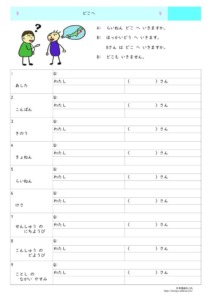
Where are you going?

(Draw a person heading to a place with a question mark on the whiteboard)

Teacher
Teacher
Ken, where are you going on Sunday?

(Draw a department store at the question mark)
I am going to the department store.
学生さん
学生さん

(Draw a person heading to a place with a question mark on the whiteboard)
Teacher
Teacher
Maria, where did you go last night?

(Draw a picture of studying at home at the question mark)
I didn’t go anywhere.
学生さん
学生さん

Teacher
Teacher
I didn’t go anywhere.


Confirming (nowhere ~ません/ませんでした)

Board Writing

けんさん、にちようびにどこへいきましたか。
            デパートへいきました。
まりあさん、きのうのばんどこへいきましたか。
            どこへもいきませんでした。


中堅さん
中堅さん
I have prepared practice materials here!!

どこへいきますかのサムネイル
You can download the materials from here


Go to (location) by (transportation).

(Use the picture from the previous introduction…)

Teacher
Teacher
The day after tomorrow, I will go to the hospital.

(Add a taxi picture to the person…)
Teacher
Teacher
The day after tomorrow, I will go to the hospital by taxi.

(Practice by replacing transportation and destinations for a while)
(Finally, replace with a picture of a person walking and encourage students to make sentences.)
The day after tomorrow, I will go to the hospital on foot.
学生さん
学生さん

Teacher
Teacher
The day after tomorrow, I will go to the hospital on foot.

Board Writing

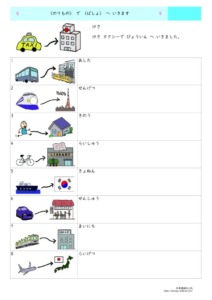
あさって、タクシーでびょういんへいきます。
きのう、バスでスーパーへいきました。
あさって、あるいてびょういんへいきます。

Practice with flashcards


中堅さん
中堅さん
I have prepared practice materials here!!

乗り物で行きますのサムネイル
You can download the materials from here


Why are you going to (location)?

(Draw a question mark on the transportation part of the board)

Teacher
Teacher
The day after tomorrow, how will you go to the hospital?

I will go by taxi.
学生さん
学生さん

(If a student answers in a full sentence like “The day after tomorrow, I will go to the hospital by taxi,” correct them to give shorter answers.)

Teacher
Teacher
The day after tomorrow, how will you go to the hospital?

I will go on foot.
学生さん
学生さん
Board Writing

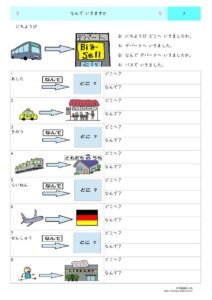
あさって、なんで   びょういんへいきますか。
     タクシーで
あさって、なんで   びょういんへいきますか。
     あるいて


中堅さん
中堅さん
I have prepared practice materials here!!

なんで行きますかのサムネイル
You can download the materials from here
 
新人君
新人君
Let’s stop here for today.
In the latter half, “with whom” and “when” will appear.
Those who want to continue, please see the page below.


新人君
新人君
It’s Lesson 4.
Verbs start appearing from this lesson onwards.

Yes…
The changes at the end of the sentence due to tense are tricky.
But don’t worry.
Even if you can’t smoothly transform the sentence endings due to tense differences in this lesson,
verbs will continue to appear in the following lessons,
so you’ll naturally be able to say them smoothly in no time.
先輩さん
先輩さん

中堅さん
中堅さん
Is it okay to say that…
If the teacher doesn’t consciously incorporate tense in practice,
it will take a considerable amount of time to master…

Well, well,
let’s first check the goals of this lesson.
To the point, it’s this!!
ベテランさん
ベテランさん

Goals of Minna no Nihongo Lesson 4

1. Be able to say the time and days of the week.
2. Understand how to construct sentences with verbs.


中堅さん
中堅さん
The time and days of the week you’ll learn in this lesson are used very frequently.
Let’s make sure to have them memorize the vocabulary thoroughly!!


Time (~時~分)

Introducing time using a clock without batteries…
Pay attention to 4 o’clock, 7 o’clock, 9 o’clock, and the differences between “fun” and “pun”, and “han”.

Board Writing
いち じ          ご  ふん
に  じ         じゅっ ぷん
さん じ         じゅう ご ふん
よ  じ        にじゅっ ぷん
ご  じ        にじゅう 五 ふん
ろく じ       さんじゅっ ぷん / はん
しち じ       さんじゅう 五 ふん
はち じ       よんじゅっ ぷん
く  じ       よんじゅう 五 ふん
じゅうじ        ごじゅっ ぷん
じゅういち じ     ごじゅう 五 ふん
じゅうに  じ   


Points to Note in This Lesson!!

Some students might add “fun” to “han” and say “9:30 minutes”, so let’s be careful.

Practice saying the time using clocks and picture cards.
Practice listening to the time said by the teacher.


What time is it?

Teacher
Teacher
What time is it now?

It’s 10:15.
学生さん
学生さん
Board Writing

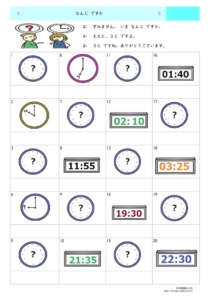
Q: いま   なん じ   ですか。
A:  10じ15ふん です。


中堅さん
中堅さん
I’ve prepared practice materials here!!

Thumbnail of What Time Is It PDF
You can download the materials from here


AM and PM

(Use a map showing world times if available…)

Teacher
Teacher
Excuse me.
What time is it in Japan now?

It’s 10:30.
学生さん
学生さん

Teacher
Teacher
Then, what time is it in Brazil now?

It’s 10:30.
学生さん
学生さん

Teacher
Teacher
What? Is it 10:30 in Brazil too?

No, it’s 10:30 PM in Brazil.
学生さん
学生さん

Teacher
Teacher
Ah, it’s 10:30 PM…


Board Writing

Q:にほん は いま なんじ ですか。
A:    ごぜん10じはん です。

Q:ブラジル は いま なんじ ですか。
A:      ごご10じはん です。


中堅さん
中堅さん
I’ve prepared practice materials here!!

Thumbnail of AM and PM PDF
You can download the materials from here


~は~曜日です。

Teacher
Teacher
Everyone, what day is it today?

It’s Wednesday.
学生さん
学生さん

Teacher
Teacher
What day is tomorrow?

It’s Thursday.
学生さん
学生さん

Teacher
Teacher
What day is the hiragana test?

It’s Friday.
学生さん
学生さん

(Be careful not to use terms like “yesterday” and “the day before yesterday” as they turn into past tense sentences like “was ~.”)

< strong>Board Writing

Q:きょう は なんようび ですか。
A:      すいようび です。

Q:あした は なんようび ですか。
A:      もくようび です。

Q:テスト は なんようび ですか。
         きんようび です。

It’s from ~ to ~.

(Draw a picture of a company with work hours and holidays written on it)

Teacher
Teacher
What are the work hours of the company?

It’s from 9 to 6.
学生さん
学生さん

Teacher
Teacher
What day is the company holiday?

It’s Saturday. And Sunday.
学生さん
学生さん
Board Writing

Q:かいしゃ は なんじ から なんじ まで ですか。
A:       9じ  から  6じ まで です。

Q:かいしゃ の やすみ は なんようび ですか。
A:      どようび と にちようび です。


Points to Note in This Lesson!!

It’s easy to remember the particle “と” (to), so they’ll naturally remember it.
However, in English, when listing three or more items, it becomes “A, B, C, and D”.
In Japanese, even when listing three or more items, you use “と” (to) every time, like “AとBとCとD”.
Make sure to explain this.


中堅さん
中堅さん
I’ve prepared practice materials here!!

 Thumbnail of What Day is it and What Time is it PDF
 
中堅さん
中堅さん
I’ve prepared such practice materials here!!

Thumbnail of From - To PDF
You can download the materials from here

Phone Numbers

(Add phone numbers to the previous whiteboard drawing)

Teacher
Teacher
What is the company’s phone number?

019 ✖✖○○ ○✖ ✖○です。
学生さん
学生さん
Board Writing

Q:かいしゃ の でんわ ばんごう は   なんばん     ですか。
A:                019 ー ✖✖○○ ー ○✖ ✖○  


Points to Note in This Lesson!!

Teach them that the hyphen in phone numbers can be read as “no”.
Also, mention that the sounds of “2” and “5” become elongated like “nii” and “goo”.

 
中堅さん
中堅さん
That’s all for now.
In the second half, verbs will appear…
Will it be alright?


Lesson 3 has a lot of vocabulary too.
Let’s naturally teach vocabulary through practice.
先輩さん
先輩さん

This is the goal for Lesson 3!
ベテランさん
ベテランさん

Objectives for “Lesson 3” in Minna no Nihongo

Be able to say where things or people are located.
Be able to ask where something was made and how much it costs to shop.


中堅さん
中堅さん
The latter part takes quite some time to practice large numbers…
Well, you can hand out printouts and say, “Please memorize them,” but it’s up to the students’ efforts after that…
It’s up to you as the teacher to decide how to proceed.

新人君
新人君
Since this lesson has a lot of content, I’ll be careful with time allocation.


Here/There/Over there is ~.

教師
教師
Here is the classroom.
There is the restroom.
Over there are the stairs.
Points to Note in This Lesson!!

“Asoko” refers to a place that is visible or can be anticipated even if not visible.


Board Writing

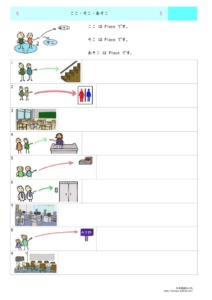
Koko wa kyoushitsu desu.
Soko wa toire desu.
Asoko wa kaidan desu.


中堅さん
中堅さん
I’ve prepared practice materials here!!

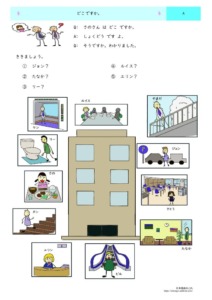
Here, There, Over there thumbnail
You can download the materials from here.


Where is ~?

(Draw a person on the whiteboard who seems to have a stomachache…)

教師
教師
Excuse me.
Where is the restroom?

(Draw another person pointing to a distant restroom… and prompt the student to answer.)
It’s over there.
学生さん
学生さん

(Draw a person holding their head on the whiteboard…)
教師
教師
Excuse me. Where is the hospital?

(Draw another person answering with a place name… and prompt the student to answer.)
It’s (place name).
学生さん
学生さん

(If it’s not visible, confirm to answer with the place name instead of using “here,” “there,” “over there.”)
Practice with pictures of items in the classroom and famous buildings in the world and Japan.

中堅さん
中堅さん
I’ve prepared practice materials here!!
It’s practice to ask where someone is!!

Where is it thumbnail
You can download the materials from here.

What floor is ~ on?

(Draw a picture of a department store on the whiteboard. Draw items on each floor.)

教師
教師
Excuse me.
Where is the camera section?
What floor is the camera section on?

It’s on the third floor.
学生さん
学生さん

教師
教師
Excuse me.
What floor is the cafeteria on?

It’s on the basement first floor.
学生さん
学生さん


Board Writing

Q: Kamera uriba wa doko desu ka?
    Kamera uriba wa nangai desu ka?
A: Kamera uriba wa sangai desu.
Q: Shokudou wa nangai desu ka?
A: Shokudou wa chika ikkai desu.


中堅さん
中堅さん
I’ve prepared practice materials here!!

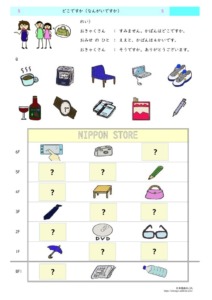
What floor thumbnail
You can download the materials from here


Which way is it? / This way, That way, That way over there

Points to Note!!

Since this is practice for switching from “koko,” “soko,” “asoko,” “doko” to “kochira,” “sochira,” “achira,” “dochira,” you can use the same picture cards you used to introduce “doko desu ka.”
Using the same situation makes it easier to understand that only the words change.


Which country are you from?

(Select a student)

教師
教師
Which country are you from, ~san?

I’m from China.
学生さん
学生さん
 
Board Writing

Q: ~san no okuni wa dochira desu ka?
A: Chuugoku desu.

Ask other students as well.
Practice with picture cards.

Points to Note in This Lesson!!

Sometimes students may misunderstand and answer with “Europe,” “America,” etc.
Confirm that it’s the name of the country, not the location.


Which company/university are you from?

Select a student (or use a picture with the name and address of a company)

教師
教師
Which company are you from, ~san?

It’s (company location).
学生さん
学生さん

教師
教師
The company name, please.

It’s (company name).
学生さん
学生さん

Practice with university and hospital names as well.

Board Writing

Q: ~san no kaisha wa dochira desu ka?
A: (Kaisha no namae) desu.


中堅さん
中堅さん
I’ve prepared practice materials here!!

Which country, which company thumbnail
You can download the materials from here
Please refer to this for teaching “Where” and “How much” in Lesson 3.
先輩さん
先輩さん

新人君
新人君
Alright, it’s Lesson 2. We will study “Kore, Sore, Are”. This is similar to Lesson 1 with the sentence pattern “~ wa ~ desu.” so it should be easy!

We’ll also learn the particle “no” which indicates possession or content!
先輩さん
先輩さん

中堅さん
中堅さん
The difference between “kore, sore, are” and “kono, sono, ano”…
Can I teach them to understand and use them correctly without mistakes?

There are also many new vocabulary words!
ベテランさん
ベテランさん

新人君
新人君
I’m starting to get worried…

Don’t worry! The vocabulary will naturally settle in through practice. As long as we teach the key points of the sentence patterns clearly, there won’t be any confusion!
先輩さん
先輩さん

The goal of this lesson is clear!!
ベテランさん
ベテランさん

Minna no Nihongo “Lesson 2” Goal

Be able to talk about the content and ownership of objects!!

中堅さん
中堅さん
Progress steadily while observing to ensure it doesn’t become a burden for learners!!

【Kore / Sore / Are】 wa ~ desu.

(Pointing to objects in the actual classroom…)

Teacher
Teacher
Kore wa enpitsu desu.
Sore wa kaban desu.
Are wa tokei desu.

Confirm the sentence pattern with flashcards
Create sentences about actual classroom objects

Board Notes

Kore wa enpitsu desu.
Sore wa kaban desu.
Are wa tokei desu.


Important Points Here!!

Note that “kore, sore, are” refer to objects that are visible.
Also, be aware that the words used differ based on the distance from oneself and the other person.
Example:
Me: Kore wa hon desu.
Person A: Sore wa hon desu.
In conversation between two people, use “kore” and “sore” regardless of how far apart they are.


中堅さん
中堅さん
I have prepared practice materials here!!

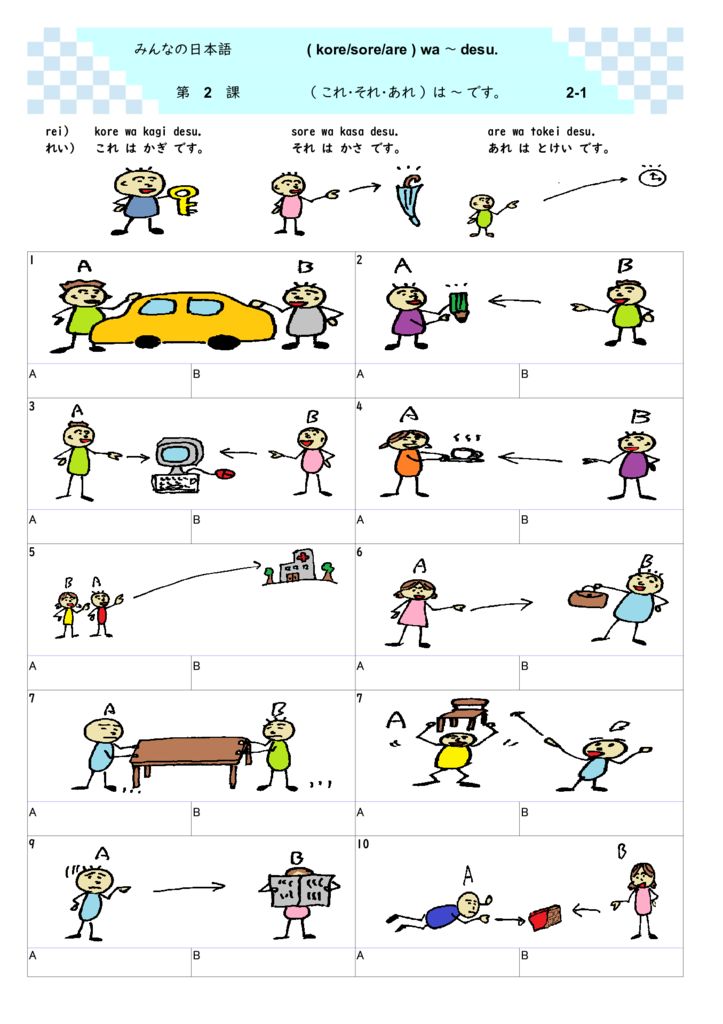
Lesson 2-1 PDF thumbnail
You can download the materials here.

Kore wa ~ desu ka.
Hai, ~ desu. / Iie, ~ ja arimasen.

(Holding a ballpoint pen)

Teacher
Teacher
Kore wa boorupen desu ka.

Hai, boorupen desu.
学生さん
学生さん

(Holding a mechanical pencil)

Teacher
Teacher
Kore mo boorupen desu ka.

Iie, boorupen ja arimasen. Shaapupenshiru desu.
学生さん
学生さん
Board Notes

Kore wa boorupen desu ka.
Hai, boorupen desu.

Kore mo boorupen desu ka.
Iie, boorupen ja arimasen. Shaapupenshiru desu.


中堅さん
中堅さん
I have prepared practice materials here!!

Lesson 2-2 Kore Sore Are? A PDF thumbnail Lesson 2-2 Kore Sore Are? B PDF thumbnail

Kore wa nandesu ka.

(Holding a pencil)

Teacher
Teacher
Kore wa nan desu ka.

Enpitsu desu.
学生さん
学生さん
Board Notes

Kore wa nan desu ka.
Enpitsu desu.


中堅さん
中堅さん
I have prepared practice materials here!!

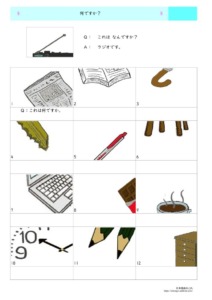
Nandesu ka PDF thumbnail
You can download the materials here

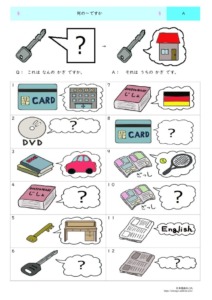
Kore wa nan no ~ desu ka. / ~ no ~ desu.

(Showing a car magazine)

Teacher
Teacher
Kore wa nan desu ka.

Zasshi desu.
学生さん
学生さん

(Pointing at the car illustration…)

Teacher
Teacher
Kore wa nan desu ka.

Kuruma desu.
学生さん
学生さん

Teacher
Teacher
Kore wa kuruma no zasshi desu.

Practice sentence patterns with flashcards.

(Holding a key…)

Teacher
Teacher
Kore wa nan desu ka.

Kagi desu.
学生さん
学生さん

Teacher
Teacher
Nan no kagi desu ka.

学生さん
学生さん

Teacher
Teacher
Tsukue no kagi desu.

Board Notes

Kore wa kuruma no zasshi desu.

Q: Kore wa nan no kagi desu ka.
A: Tsukue no kagi desu.


中堅さん
中堅さん
I have prepared practice materials here!!

Nano PDF thumbnail
Japanese grammar material “Nano ~ desu ka”

You can see the latter half of Lesson 2 on this page.
先輩さん
先輩さん


新人君
新人君
It’s finally time to start learning grammar today.
First, we’ll begin with Lesson 1.
The class has just started, so it’s a bit nerve-wracking.

Well, don’t worry too much!
The class atmosphere improved a bit during the introduction of greetings, didn’t it?
This time, let’s think together about how to flow through Lesson 1!!
先輩さん
先輩さん

新人君
新人君
In Lesson 1, we’ll be learning the basic Japanese sentence pattern “~は~です“, right?

Ah, that’s right.
The goal for this lesson is precisely this!!
Veteran
Veteran

Goals for Minna no Nihongo “Lesson 1”

To be able to talk about oneself and others

中堅さん
中堅さん
Structure the lesson around this goal…
If by the end of this lesson, they can introduce their nationality, job, and age, then they’ve passed…
新人君
新人君
Yes, I will prepare thoroughly!!
Here are some common difficulties in this lesson:
Below are the points to watch out for!!
先輩さん
先輩さん

Points to watch out for in this lesson!!

Q&A using “Ano kata wa donata desu ka?” and “~san desu. ~ no ~ desu.”
The sentence patterns are long and hard to remember.
Since they are not frequently used, they do not stick.
Focus on learning the use of 「の」 here!!

中堅さん
中堅さん
Well, they aren’t used often, and even if they memorize the phrases, they quickly forget them.
Once they get more accustomed to Japanese, they will naturally start using them.

 ~は~です。(Nationality)

Now, it’s time to practice sentence patterns.
This is the first sentence pattern learners will study.
Be mindful of the blackboard as you proceed with the class.
先輩さん
先輩さん

Self-introduction

Teacher
Teacher
Watashi wa Tanaka desu.
Watashi wa Nihonjin desu.

Have each student introduce themselves one by one.
If there are many students, those waiting for their turn may get bored.
If there are many students, create and distribute a self-introduction sheet so they can freely introduce themselves to each other.
If there is really no time, call on a few students to quickly go through it.

 
Blackboard

Watashi wa Tanaka    desu.
Watashi wa Nihon jin desu.

Introducing Others

Teacher
Teacher
Kochira wa Riza-san desu.
Riza-san wa Amerika-jin desu.

Practice sentence patterns with flashcards.
If there aren’t many students, take turns introducing the person next to you.

 
Blackboard

Kochira wa Riza-san desu.
Riza-san wa Amerika-jin desu.


中堅さん
中堅さん
I’ve prepared some practice materials here!!

~は~です(国籍)のサムネイル
You can download the materials here.

~は(Occupation)です。

Teacher
Teacher
Watashi wa kaishain desu.
Riza-san wa isha desu.

Practice sentence patterns with flashcards.
(If it’s a class for working adults, have them say their occupations.
It can be a hassle to confirm the vocabulary of the occupations that come up…)

 
Blackboard

Watashi wa kaishain desu.
Riza-san wa isha desu.

中堅さん
中堅さん
If you let students in a class of international students go in turns,
they’ll all say “Watashi wa gakusei desu” and it’ll be a failure…
Practice various occupations with flashcards…

中堅さん
中堅さん
I’ve prepared some practice materials here!!

~は~です(職業)jaのサムネイル
You can download the materials here.


~は~(Age)です。

中堅さん
中堅さん
The next item in the text is “~ja arimasen.”
Hmm, should we introduce “~wa (age) sai desu.” first instead,
following the flow of “~wa~desu”?

That’s not a bad idea.
You can also align nationality, occupation, and age vertically on the blackboard!!
Veteran
Veteran

ーーーーーーーーーーーーーーーーーーーーーーーーーーーーーーーーーーーーーーーーーーーーーー

Teacher
Teacher
Watashi wa sanjuhassai desu.
Riza-san wa nijugosai desu.

Blackboard

Watashi wa 38-sai desu.
Riza-san wa 25-sai desu.

新人君
新人君
When everyone reads off the blackboard,
won’t they get stuck at the numbers?
That’s okay.
Use that as a transition to “learning numbers,”
and once they can read the numbers, they’ll be able to say their age.
That leads to a sense of achievement as
they feel they’ve increased their ability to express themselves with new sentence patterns (knowledge).
先輩さん
先輩さん

Introduction of Numbers (1-100)

Confirm special readings like issai (1 year old), hassai (8 years old), jussai (10 years old),
and also hatachi (20 years old). These come up often in listening comprehension.
Once they have a general grasp of number readings,
use flashcards to confirm how to say ages.


中堅さん
中堅さん
I’ve prepared some practice materials here!!

Numbers thumbnail
You can download the materials here.

How old are you?

Teacher
Teacher
Q: ~san wa nansai desu ka?
A: 26-sai desu.

Confirm with a few students, and once you feel they understand the meaning of “how old are you,”
practice by having them take turns asking the person next to them.

 
Blackboard

Riza-san wa nansai desu ka.
        26-sai desu.
Yamada-san wa oikutsu desu ka.
        56-sai desu.

 
中堅さん
中堅さん
I’ve prepared some practice materials here!!
This time it’s pair work!!
Pair work is good because it’s easy to have them practice asking and answering questions.
It gives all students a chance to speak at once.

The teacher only needs to check if the students are speaking correctly,
so it’s easy!!
Veteran
Veteran

Age thumbnail
You can download the materials here.

That’s all for today.
The second half will cover “~ja arimasen” and “~desu ka” teaching plans and materials.
先輩さん
先輩さん

新人君
新人君
This is Lesson 16 of Minna no Nihongo.
In this lesson, we will continue learning sentence patterns using the “te-form”.

Everyone seems to be getting better at forming the “te-form”.
先輩さん
先輩さん

中堅さん
中堅さん
Don’t forget that in the latter part, there are sentence patterns for adjectives.
Students might also forget some vocabulary for adjectives…

These are the goals for this lesson!!
ベテランさん
ベテランさん

Goals of Lesson 16 in Minna no Nihongo

“Be able to explain daily actions in sequence”
“Be able to describe things and places by connecting adjectives”


~て、~て

Key Points

Be careful as the difference between “~て、~て” and “~てから” can be difficult to understand.
It’s easier to explain with examples: use “~て~て” for continuous actions, and “~てから” for actions that occur after A finishes and B starts.


(Draw a picture of a vending machine on the whiteboard)
教師
教師
Everyone, you want to buy a juice.
What do you do first?

Insert money.
学生さん
学生さん

教師
教師
You inserted the money.
What do you do next?

Press the button.
学生さん
学生さん

教師
教師
That’s right.
You insert the money and then press the button.

(Draw a picture of a station on the whiteboard)
教師
教師
We are going to take the train now.
What do you do?

Buy a ticket.
学生さん
学生さん

教師
教師
You buy a ticket and then take the train.
Board Writing

おかね を いれて、ボタン を おします。
きっぷ を かって、でんしゃ に のります。


~て、それから・・・

When connecting three actions, pay attention to the position of “sorekara” (then).
先輩さん
先輩さん

(Draw pictures on the whiteboard of brushing teeth, washing face, and a person heading to work with a bit of space in between)
(Encircle the brushing teeth and washing face pictures, then draw an arrow connecting to the picture of the person heading to work)</ p>

教師
教師
What does this person do every morning?

Brushes teeth, washes face, and goes to work.
学生さん
学生さん

教師
教師
That’s right.
At home, he brushes his teeth and washes his face. After that, he goes to work.
“It’s better to say, ‘Brushes teeth, washes face, then goes to work.'”

(Draw a picture of a person withdrawing money at a bank, heading to a supermarket, and buying fish on the whiteboard)

Withdraw money at the bank, go to the supermarket, then buy fish.
学生さん
学生さん

教師
教師
Hmm…
Withdraw money, then go to the supermarket and buy fish.
That sounds better.

(Draw an arrow from the picture of the person withdrawing money to the picture of the person heading to the supermarket and buying fish, encircling the latter two)


中堅さん
中堅さん
I’ve prepared practice materials here!!

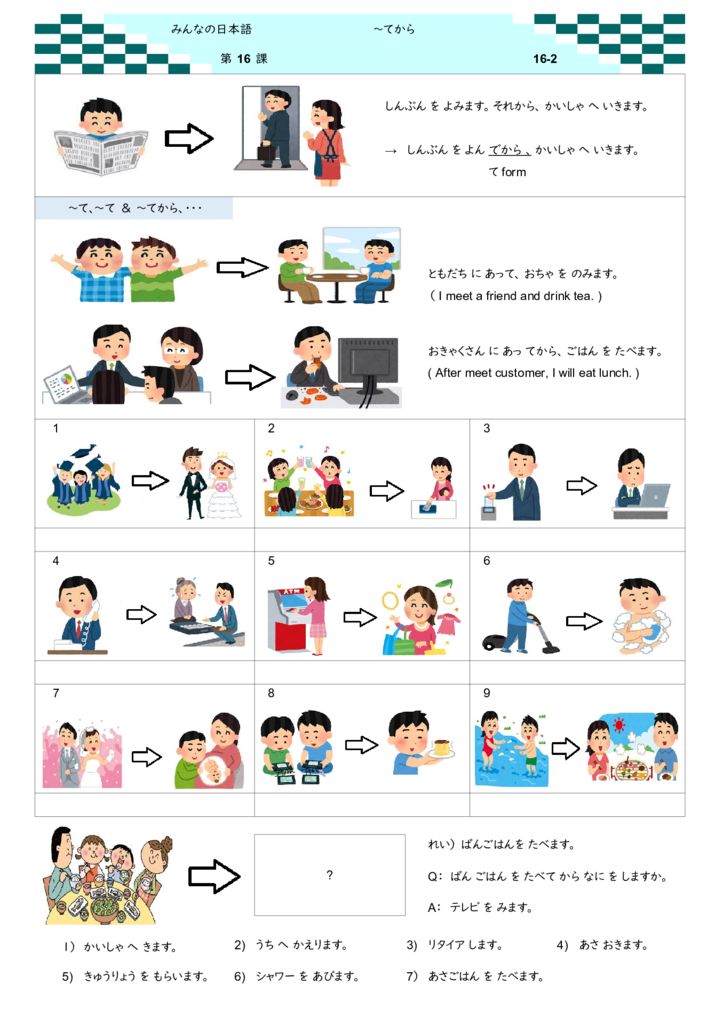
それから・・・ → ~てから・・・

(Just replace “sorekara” on the whiteboard with “tekara”)
Practice with flashcards

~て~て VS ~てから(それから)

Explain the difference between “~て、~て” and “sorekara/~てから” to students who haven’t understood it yet.

Board Writing

➀Meet the company’s clientand have dinner.
②Meet the company’s clientthen have dinner.


教師
教師
Are they the same or different?

……
学生さん
学生さん

Key Points

➀ is… (draw a picture on the whiteboard of a client and you having dinner together)
② is… (draw a picture on the whiteboard of finishing the business meeting with the client and having dinner alone)
Other examples,
➀ Go to the bathroom and take a shower. (bathroom and shower are in the same room)
② Go to the bathroom then take a shower. (bathroom and shower are in different rooms)
Explain while drawing such pictures.


中堅さん
中堅さん
I’ve prepared practice materials here!!


~てから何をしますか。(Question)

教師
教師
What do you do after you wake up in the morning?

I eat breakfast.
Brush my teeth.
Go to the bathroom.
学生さん
学生さん

教師
教師
What did you do after you got home yesterday?

I watched TV.
Read a book.
Took a shower.
学生さん
学生さん

教師
教師
What do you want to do after returning to your country?

I want to work at a Japanese company.
I want to eat my mother’s cooking.
I want to meet my friends.
学生さん
学生さん
中堅さん
中堅さん
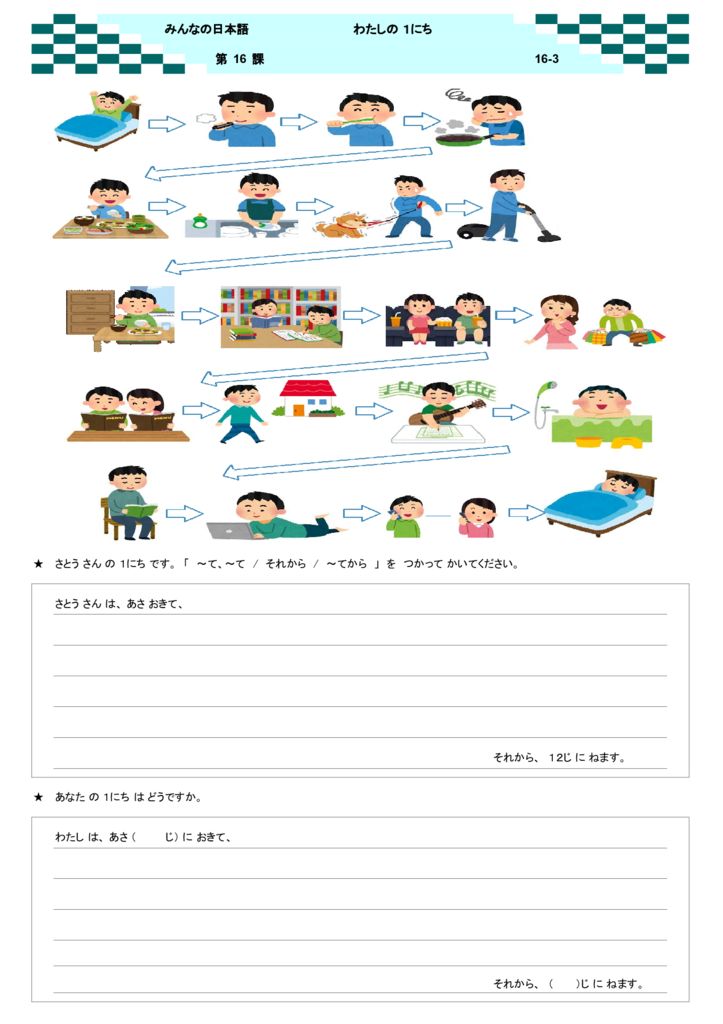
Now, let’s write an essay…

 
There are more materials here!!
ベテランさん
ベテランさん
 

How to (Steps)

(Draw a picture of an ATM on the whiteboard)

教師
教師
This is an ATM.
How do you use it?

(Make sentences step by step by asking students to provide the steps)

Board Writing
  1. First, insert the card.
  2. Enter the PIN.
  3. Enter the amount.
  4. Take the money.
  5. Take the card.
  6. Take the receipt.

First, insert the card,
next, enter the PIN,
enter the amount,
then take the money,
take the card,
take the receipt.

Other examples:
How to use a microwave.
How to make cup noodles.
How to get to ~ (train transfers).
How to get home.
Try making various sentences.

中堅さん
中堅さん
That’s it for today…
We’ll continue next time.

新人君
新人君
Sigh…
This is lesson 15.
It’s difficult to convey the concept of “~ています” in the latter half.

Well, don’t say that,
the first half of this lesson, “~てもいいです。” and “~てはいけません。” are easy to teach.
先輩さん
先輩さん

中堅さん
中堅さん
Indeed, the latter half is complicated.
“~ています” is used in various contexts like “status, continuity, repetition”.

Even Japanese people use it unconsciously, so
it’s difficult for both the teachers and learners to understand!
We need to give examples carefully, one by one, to help understand the situations!!
ベテランさん
ベテランさん

新人君
新人君
The goal of this lesson is…
Let’s see…

Goal of “Lesson 15” in Minna no Nihongo

“To ask for permission and inquire if something is possible.”
“To talk about things you do regularly or about your status.”


~てもいいですか

(Draw a picture on the whiteboard of a person who is feeling hot and holding a remote, asking something to others)

Teacher
Teacher
Everyone, what does this person say?

May I turn on the air conditioner?
Is it okay to turn on the air conditioner?
Student
Student

Teacher
Teacher
What is the “te-form” of “つけます” (to turn on)?

It is “つけて”.
Student
Student

Teacher
Teacher
Yes, you say “エアコンをつけてもいいですか。”

(Draw a picture of a person who is troubled because they don’t have a pen)

Teacher
Teacher
What does this person say?

May I borrow a pen?
Student
Student

Points

※ Some students might mistakenly say “貸してもいいですか。” (May I lend?). Explain that “借りても…” (May I borrow…) should be used for their own actions.

Deepen understanding of sentence patterns using flashcards and practice asking for permission.

Board Writing

エアコン を つけます。 いいですか。
       つけても いいですか。

ボールペン を かります。 いいですか。
       かりても いいですか。

& nbsp;

中堅さん
中堅さん
I’ve prepared practice materials here!!

Thumbnail of Lesson 15, Part 1 (Permission)


Q: ~てもいいですか。(Personal belongings)
A: Sure, go ahead. / Sorry, but…

Teacher
Teacher
Excuse me, A-san.
May I borrow a pencil?

Yes, you may borrow it.
Student
Student

Teacher
Teacher
“Sure, go ahead” is better.

Teacher
Teacher
Excuse me, B-san.
May I borrow 10,000 yen?

No, um… I can’t borrow? Not good?
Student
Student

Teacher
Teacher
Instead of “No”,
“Sorry, but…” is better.
“Sorry, but… I don’t have it now.” is also good.

Teacher
Teacher
Excuse me, C-san.
May I turn off the air conditioner?

Sorry, but…
It’s hot…
Student
Student

Practice various situations with flashcards.
When responding, add reasons to practice sentence construction.

Board Writing

Q: ボールペン を かりてもいいですか。
A: Sure, go ahead.

Q: 10,000 yen かりてもいいですか。
A: Sorry, but…

Q: エアコン を けしてもいいですか。
A: Sorry, it’s hot…


中堅さん
中堅さん
I’ve prepared practice materials here!!

 Thumbnail of Lesson 15, Part 3 (Prohibition) Thumbnail of Lesson 15, Part 4 (Permission/Prohibition)

There’s more material here too!
先輩さん
先輩さん


Q: ~てもいいですか。(Rules)
A: Yes, you may. / No, you may not.

(Draw a picture of a hospital on the whiteboard)

Teacher
Teacher
This is a hospital.
Is it okay to read books in the hospital?

Sure, go ahead.
Student
Student

Teacher
Teacher
Since it’s a hospital rule,
“Yes, you may read” is better.

Teacher
Teacher
Is it okay to smoke in the hospital?

Sorry, but…
Student
Student

Teacher
Teacher
Since it’s a rule.
“Sorry, but…” is not good.
Use “No, you may not smoke.”.
“いけません。” means “No”. (Show the prohibition mark)

Practice “~てはいけません” with flashcards
Practice saying prohibitions by giving place names.
Practice creating appropriate sentences using “~てもいいです” and “~てはいけません” given the reasons.

Board Writing

Q: Can you read a book in the hospital? Yes, you may.

Q: Can you smoke in the hospital?

A: No, you may not.


中堅さん
中堅さん
I’ve prepared practice materials here!!

 Thumbnail of Lesson 15, Part 3 (Prohibition) Thumbnail of Lesson 15, Part 4 (Permission/Prohibition)

There’s more material here too!
先輩さん
先輩さん

 Various materials for teaching Japanese grammar “~てもいいです / ~てはいけません”

中堅さん
中堅さん
This sentence pattern is long and hard to remember…

The latter half is tough too!!
ベテランさん
ベテランさん

新人君
新人君
We’re already on Lesson 14 of “Minna no Nihongo.”
The “te-form” is finally making its appearance.

From this lesson, we’ll be learning various forms consecutively.
先輩さん
先輩さん

中堅さん
中堅さん
Before the “te-form,”
we need to first remember how to divide verbs into groups…
Then, the detailed rules for Group 1…

Don’t worry!
Once you firmly remember the “te-form,” many sentence patterns will be easier to remember!!
Prioritize learning the transformation rules of the forms!
ベテランさん
ベテランさん

中堅さん
中堅さん
The goal of this lesson is…

Goals of “Minna no Nihongo” Lesson 14

“Be able to use expressions for making requests, suggestions, and offers.”
Talk about what you are doing using the present continuous tense.


Introduction to the Present Continuous Tense → Introduction to the Te-form

(Draw a picture on the whiteboard of a person about to eat a meal)

Teacher
Teacher
I am about to eat a meal.
“Itadakimasu”

(Draw a picture on the whiteboard of a person who has finished eating)
Teacher
Teacher
I just ate a meal.
“Gochisosama deshita.”

(Draw a picture between the two of a person in the middle of eating a meal)
Teacher
Teacher
I am eating a meal now.
“Tabemasu” becomes “tabeteimasu”.
“Masu” becomes “teimasu”.

(Draw a picture on the whiteboard of a person drinking water)

Teacher
Teacher
Everyone, this person is…

drinking water.
学生さん
学生さん

Teacher
Teacher
No, that’s wrong.
“Nomiteimasu” is incorrect.
It’s “nondeimasu.”

???
学生さん
学生さん

(Write “nomimasu I” and “tabemasu II” on the whiteboard)

Verb Grouping

Continuing from earlier…

Points

Check the vocabulary list of Lesson 14 together.
Once you confirm that there are I, II, and III groups, let them think about how they are divided by rules.

Teacher
Teacher
“Nomimasu” is Group 1. “Tabemasu” is Group II.
“Suuimasu” is Group I. “Agemasu” is Group II.
Then, how about “Kakimasu”?

It’s Group I.
学生さん
学生さん

Sharp students will notice the rule quickly!!
ベテランさん
ベテランさん
Points

Explain that if the sound before “masu” is
“i”, it’s Group I, “e”, it’s Group II, and “shimasu”, “kimasu” are Group III.

Practice grouping verbs for a while without irregular verbs.

Once they get used to it…

Teacher
Teacher
How about “Mimasu”?

It’s Group I.
学生さん
学生さん

Teacher
Teacher
No, it’s Group II.

Explain that when there is only one sound before “masu”, it is also Group II. (Examples: imasu, nemasu, mimasu, etc.)

Teacher
Teacher
Then, how about “Okimasu”?

It’s Group I!!
学生さん
学生さん

Teacher
Teacher
No, “okimasu” is Group II.

???
学生さん
学生さん
Points

Explain that there are special Group II verbs like “okimasu, karimasu, dekimasu”, etc.

After confirming all the rules, practice grouping with oral or flashcards again

Board Writing

Group I
~「i」+masu   ・・・「nomimasu, ikimasu, asobimasu」

Group II
~「e」+masu   ・・・「tabemasu, akemasu, oshiemasu」
one sound + masu  ・・・「mimasu, nemasu, imasu」
Specials      ・・・「okimasu, karimasu, abimasu, dekimasu, orimasu」

Group III     ・・・「shimasu / kimasu」


中堅さん
中堅さん
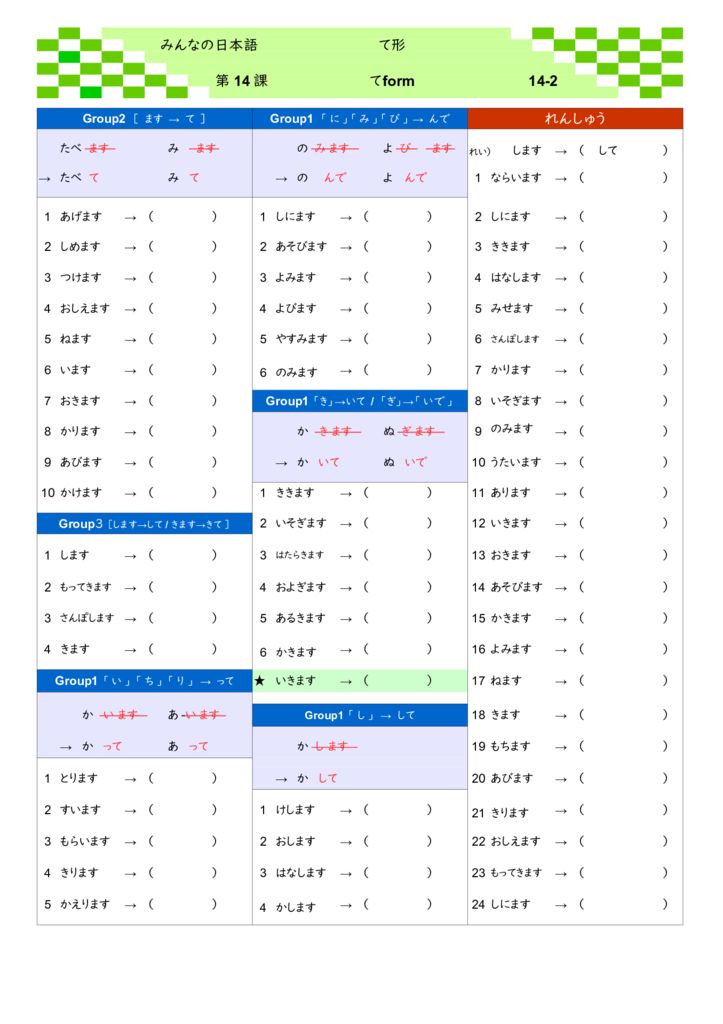
I have prepared practice materials here!!

Te-form Rules

(Going back to the “~ています” picture from earlier…)

Teacher
Teacher
“Gohan wo tabemasu.”
“Tabemasu” becomes “tabeteimasu”.
“Tabete” is the “te-form”.

(Draw a picture of a person opening a window)

Teacher
Teacher
The window…

The window is open.
学生さん
学生さん
 
Board Writing

Te-form
Group II / Group III (masu → te)
II tabemasu → tabete
  akemasu → akete
III shimasu  → shite
  kimasu  → kite

Gohan wo tabete + imasu.
Mado  wo akete + imasu.

(Using the picture of drinking water from earlier…)

Teacher
Teacher
Drinking water.

(Draw a picture of a person smoking a cigarette)
Smoking a cigarette.
学生さん
学生さん

Teacher
Teacher
“Sundeimasu” is incorrect.
It’s “sutteimasu.”

Te-form
Group I
i, chi, ri → tte su i  masu   ma chi  mas   kae ri  mas 
           su tte    ma tte    kae tte

ni, mi, bi → nde shi ni  mas   no mi  mas   aso bi  mas 
           shi nde    no nde    aso nde

ki → ite     ka ki  mas   ki ki  mas 
           ka ite    ki ite

gi → ide     oyo gi  mas   iso gi  mas 
           oyo ide    iso ide

shi → shite     hana shi  mas   ka shi  mas 
           hana shite    ka shite

Smoking a cigarette.
Drinking water.
Writing a letter.

Once all the rules are confirmed, practice making te-forms.
After memorizing the te-form, practice sentence patterns using “~teimasu” with flashcards.

中堅さん
中堅さん
I have prepared practice materials here!!

新人君
新人君
Now, in the second half, we will learn sentence patterns using the te-form.

Once you properly memorize the te-form,
it’s easy!!
ベテランさん
ベテランさん

新人君
新人君
This is lesson 13.
“I want to do ~.” “I’m going to ~.”
These are sentence patterns using the “masu” form.

It’s easy because you just replace “masu” with another word.
先輩さん
先輩さん

中堅さん
中堅さん
Making sentences is easy, but listening to sentences like “mi ni ikimasu” and “shi ni ikimasu” is difficult…

If you emphasize that “~hoshii” and “~tai” are adjectives, it should be fine!
ベテランさん
ベテランさん

新人君
新人君
The negative form of “~tai desu,” “~takunai desu,” seems hard to remember too.

This is the goal for this lesson!!
先輩さん
先輩さん

Goals for Lesson 13 of “Minna no Nihongo”

Communicate what you want or want to do
Communicate the purpose of going somewhere

In this lesson, students will make sentences using “kara” (because) to express reasons, using previously learned sentence patterns and vocabulary. It’s a great review opportunity!!
ベテランさん
ベテランさん
新人君
新人君
You can get the materials on this page.

 Japanese Grammar Materials: “I want to do ~ / I don’t want to do ~”


~が欲しいです。

(Draw a person who looks thirsty on the whiteboard. Draw a speech bubble and a picture of water.)

Teacher
Teacher
I’m thirsty, so I want water.

(Draw a person who looks hungry on the whiteboard…)

Teacher
Teacher
I’m hungry, so…

I want food.
学生さん
学生さん

(Draw various other pictures…)

Teacher
Teacher
I’m lonely, so…

I want a boyfriend.
学生さん
学生さん

Teacher
Teacher
I have a lot of work, so…

I want time.
学生さん
学生さん

Practice with flashcards, creating sentences with given clauses.

~が欲しくないです。

Teacher
Teacher
Everyone, tomorrow is a holiday.
Do you want homework?

No, I don’t want it.
学生さん
学生さん

Teacher
Teacher
“Hoshii” is an “i-adjective.”

No, I don’t want it.
学生さん
学生さん

Practice with other YES/NO questions.

Board Notes

(Noun) が ほしい です。
I want money.
I want time.
I want water.

Q: Do you want a bag?
A: Yes, I want it.
No, I don’t want it.


What do you want?/ What kind of ~ do you want?

Teacher
Teacher
Mr. A, what do you want for your birthday?

I want a shirt.
学生さん
学生さん

Teacher
Teacher
What kind of shirt do you want?

I want a nice shirt.
学生さん
学生さん

Ask other students as well.

Points

Confirm that when answering, “Noun + no + Noun,” “i-adjective + Noun,” and “na-adjective + na + Noun” will appear.


Board Notes

Q: What do you want?
A: I want a shirt.

Q: What kind of shirt do you want?
A: I want a nice shirt. (na-adjective)
I want an expensive shirt. (i-adjective)
I want a Japanese shirt. (Noun)


中堅さん
中堅さん
I’ve prepared practice materials here!!

Thumbnail of Lesson 13 13-1 (Want)

~たいです。

Points

If sentences like “nemasu ga hoshii desu” appear in the “I want ~” section, you can introduce this naturally.


(Draw a person who looks like they want to eat cake on the whiteboard)

Teacher
Teacher
I want to eat cake.

(Draw a person pointing at a movie theater)
Teacher
Teacher
I want to watch a movie.

(Draw a person who looks like they want to smoke on the whiteboard)

Teacher
Teacher
I want to smoke…

I want to smoke.
学生さん
学生さん

Practice with flashcards.
Provide a reason (first clause) and practice creating sentences with “~tai” (second clause).
Example: (Head hurts, so…) I want to go home.
(I’m tired, so…) I want to rest.

Board Notes

I want to eat cake.
I want to watch a movie.
I want to smoke.


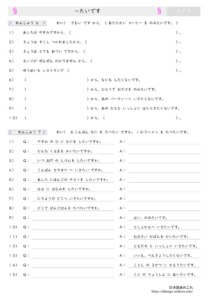
中堅さん
中堅さん
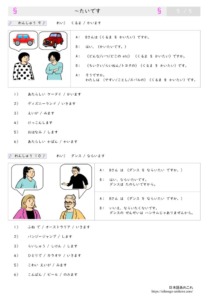
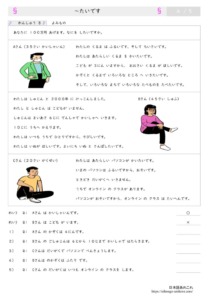
I’ve prepared practice materials here!!

Thumbnail of Thumbnail of
You can download the materials here


What do you want to do? / What kind of ~ do you want to do?

Teacher
Teacher
Mr. A, what do you want to eat tonight?

I want to eat fish.
学生さん
学生さん

Teacher
Teacher
Mr. B, what do you want to do on Sunday?

I want to buy a bag at the department store.
学生さん
学生さん

Teacher
Teacher
What kind of bag do you want to buy?

I want to buy a small bag.
学生さん
学生さん

Introduce this by asking other questions as well.

Board Notes

Q: What do you want to eat?
A: I want to eat fish.

Q: What kind of bag do you want to buy?
A: I want to buy a small bag.

Q: Where do you want to eat lunch?
A: I want to eat at Matsuya.

Q: When do you want to go back to your country?
A: I want to go back in April next year.


~たいです。 / ~たくないです。

Teacher
Teacher
Everyone, do you want to have a party at school tomorrow?

Yes, I do.
学生さん
学生さん

Teacher
Teacher
Do you want to have a test tomorrow?

No, I don’t want…
学生さん
学生さん

Teacher
Teacher
“~tai” is an “i-adjective.”

No, I don’t want to.
学生さん
学生さん

Ask a few more questions to confirm the sentence pattern.

Board Notes

Tomorrow, I want to have a party.
Tomorrow, I don’t want to have a test.

Tonight, I want to drink beer.
Every night, I don’t want to drink beer.


中堅さん
中堅さん
I’ve prepared practice materials here!!

Thumbnail of Thumbnail of Thumbnail of
You can download the materials here

中堅さん
中堅さん
This should be fine for now.

Now, let’s continue to the second half!!
ベテランさん
ベテランさん