Teaching Plans and Materials for “Minna no Nihongo” Lesson 6: How to teach “Daily used verbs”
This lesson is about studying verbs used in daily life.
they will be able to express more things,
making it more fun to speak in Japanese.
you can also build closer relationships with students…
I can ask students various questions
to create an ice-breaking time!!

“To be able to talk about daily life using verbs"
“To be able to invite people"
~を(verb)./(person)にあいます。
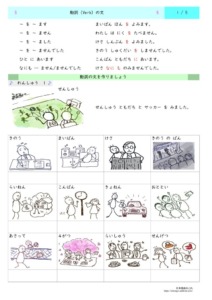
(Draw pictures of people doing various things on the whiteboard)
(Pointing to the part of the picture where it says “tonight" and shows eating fish…)
Teacher これはなんですか。 (What is this?) さかな です。(It’s a fish.) 
学生さん |
(Pointing to the picture of the person eating…)
たべます。(I eat it.)
学生さん
Teacher こんばん わたし は さかな を たべます。(Tonight, I will eat fish.) |
Use flashcards of drinks, books, cigarettes, etc. to check the sentence patterns.
(Pointing to the part of the picture where it says “last week" and shows meeting a friend…)
(Pointing to the picture of the action of meeting…)
|
せんしゅう ともだち を あいました。(I met a friend last week.)
学生さん
Teacher せんしゅう ともだち に あいました。(I met with a friend last week.) |
In this lesson, continue to introduce verbs with “affirmative/negative" and “present/past" in mind.
I think this will help students to use them more smoothly.
あした さかな を たべます。
きのう ビール を のみました。
まいばん テレビ を みます。
せんしゅう ともだち に あいました。
(Tense) ~ますか。/ ~ましたか。
Yes, ~ます。/ ~ません。
No, ~ません。/ ~ませんでした。
(Adding a question mark to the notes on the board)
|
Teacher ~さん、あした さかな を たべますか。(Will you eat fish tomorrow?) はい、たべます。(Yes, I will eat it.)
学生さん
Teacher ~さん、きのう ビールを飲みましたか。(Did you drink beer yesterday?) いいえ、飲みませんでした。(No, I didn’t.)
学生さん |
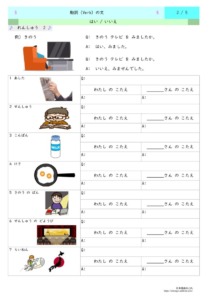
Q: あした さかな たべますか?
A: はい、たべます。
いいえ、たべません。
Q: きのう ビール のみましたか?
A: はい、のみました。
いいえ、のみませんでした。
Q: せんしゅう ともだち にあいましたか?
はい、あいました。
いいえ、あいませんでした。
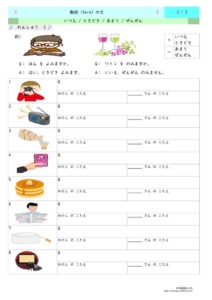
Q: ~ますか。
A:Yes, (always/ sometimes) ~ます。
No, (not much/ never) ~ません。
(Draw a weekly schedule on the whiteboard)
げつようび ビール を のみます。
かようび も ビール を のみます。
すいようび も ビール を のみます。
もくようび も、きんようび も、どようび も、にちようびも…。 (Ken drinks beer on Monday. He drinks beer on Tuesday. He drinks beer on Wednesday. Thursday too, Friday too, Saturday too, and Sunday too…)
(Adding circles under each day)
げつようび と すいようび と きんようび テレビ を みます。
ミカさん は ときどき テレビ を みます。 (Mika watches TV on Monday, Wednesday, and Friday. Mika sometimes watches TV.)
Introduce “not much" and “never" in the same way.
ケンさん いつも ビールをのみます。
ミカさん ときどき テレビをみます。
エドさん あまり ビールをのみません。
わたし ぜんぜん テレビをみません。
(Ken always drinks beer. Mika sometimes watches TV. Ed doesn’t drink much beer. I never watch TV.)
|
Teacher Aさん は ビール を のみますか。(A-san, do you drink beer?) はい、ときどき のみます。(Yes, sometimes I do.)
学生さん
Teacher Bさん は えいが を みますか。(B-san, do you watch movies?) いいえ、あまり みません。(No, I don’t watch them much.)
学生さん |
Once students have learned about frequency, practice QA by asking questions.
Remember that “very" and “sometimes" are used in affirmative sentences,
while “not much" and “never" are used in negative sentences.
Sometimes students make mistakes like saying “I eat not much."
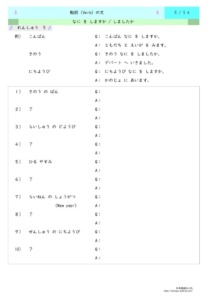
What do you (verb)?
(Draw a picture of a person eating something on the whiteboard. What is it? Mark)
|
Teacher ~さんは こんばん なに を たべますか。(What will you eat tonight?) さかな を たべます。(I will eat fish.)
学生さん
Teacher ~さん は けさ なに を のみましたか。(What did you drink this morning?) コーヒー を のみました。(I drank coffee.)
学生さん
Teacher ~さん は きのう だれ に あいましたか。(Who did you meet yesterday?) ともだち に あいました。(I met a friend.)
学生さん |
Encourage students not only to answer but also to create questions.
In the practice so far, if answers like “nothing" or “no one" come out of the students’ mouths,
you can introduce them at that time.
If it doesn’t come up, draw a picture or explain orally.
“There is no one to meet." might come up as an answer.
Explain that “no one" connects naturally with “to meet" and that “に" cannot be omitted.
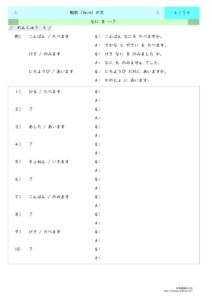
Q: こんばん なにを たべますか?
A: さかなをたべます。
なにもたべません。
Q: けさ なにを のみましたか?
A: コーヒーをのみました。
なにものみませんでした。
Q: きのう だれに あいましたか?
ともだちにあいました。
だれにもあいませんでした。
What did you do?
(Write “Sunday" on the whiteboard and draw various activities below it)
(Pointing to the picture of reading a book)
(Pointing to the picture of going to the supermarket)
(Pointing to the picture of meeting a girlfriend)
The answer to “What do you do? / What did you do?" doesn’t always have to use “~をします。/~をしました。".
Make sure that students can freely use other verbs.
It’s also good to introduce and practice “nothing" here.
Q: にちようび なにをしましたか?
A: ほんをよみました。
スーパーへいきました。
かのじょにあいました。
なにもしませんでした。
In the second part, we will learn “verb + at place", “won’t you", and “let’s".